
The most expensive mistake a homeowner can make in 2026 isn’t choosing the wrong tile, but selecting a funding strategy that outlives the renovation itself. While average HELOC rates have stabilized near 7.29 percent this September, many families still feel paralyzed by the complexity of modern home remodeling financing options. It’s understandable to feel hesitant when the fear of property liens or uncertain returns on investment weighs as heavily as the project’s blueprints.
As licensed professionals serving the San Francisco Bay Area and Sacramento, we provide a detailed comparison of current loan structures to help you identify the safest financial path. By aligning your funding with the expected lifespan of your improvements, you can proceed with the confidence that your monthly budget remains secure. This guide examines how to navigate complex application hurdles and select a strategy that balances your aesthetic goals with long-term fiscal health. You will gain a clear understanding of the monthly impact on your budget and how working with a qualified contractor ensures your project meets the rigorous standards required by modern lenders.
Key Takeaways
- Differentiate between secured and unsecured funding to ensure you select a path that aligns with your risk tolerance and property goals.
- Compare the flexibility of HELOC draw periods against the stability of lump-sum home equity loans for large-scale additions and fixed-cost projects.
- Identify the fastest home remodeling financing options for time-sensitive needs, such as roofing repairs, where immediate funding prevents further property damage.
- Navigate specialized government-backed programs, including FHA Title 1 and HUD 203(k) loans, which are ideal for homeowners with limited equity or those purchasing fixer-uppers.
- Learn to match your chosen financing structure to the expected lifespan of your renovation to ensure your investment provides lasting peace of mind.
Understanding Home Remodeling Financing Options: A 2026 Overview
Home remodeling financing options are more than just a means to cover expenses; they represent a strategic tool for preserving personal liquidity while enhancing property value. In the current 2026 market, many homeowners find that financing major structural renovations allows them to maintain an emergency fund while tackling essential upgrades. This approach ensures that high-priority projects, such as new home construction or a complex kitchen remodel, receive the high-quality materials and meticulous craftsmanship they deserve without depleting cash reserves. By spreading the cost over time, you can invest in the durability and aesthetic integrity of your property without compromising your monthly financial stability.
Before submitting any application, securing a detailed estimate from a licensed general contractor is vital. Lenders require precise, professional documentation to verify that the requested funds align with the actual market costs of the proposed work. As a licensed professional in the SF Bay Area and Sacramento, GTE Construction helps ensure that your project meets the rigorous standards required by modern lenders. A thorough estimate provides a roadmap for the bank, demonstrating that the project is a sound investment in the home’s longevity.
The Role of Project Scope in Financial Planning
Strategic planning begins with identifying whether a project is maintenance-driven or lifestyle-driven. A roofing repair or gutter installation protects the structural integrity of the home, whereas a bathroom remodeling project focuses on aesthetic and functional longevity. In competitive markets like Sacramento and the San Francisco Bay Area, the return on investment (ROI) often varies significantly based on these categories. Structural stability is a non-negotiable requirement for future resale value. In a 2026 California context, the loan-to-value ratio is the percentage of your home’s appraised value that a lender is willing to finance, calculated by dividing the total loan amount by the property’s current market value.
Secured vs. Unsecured Financing: The Core Difference
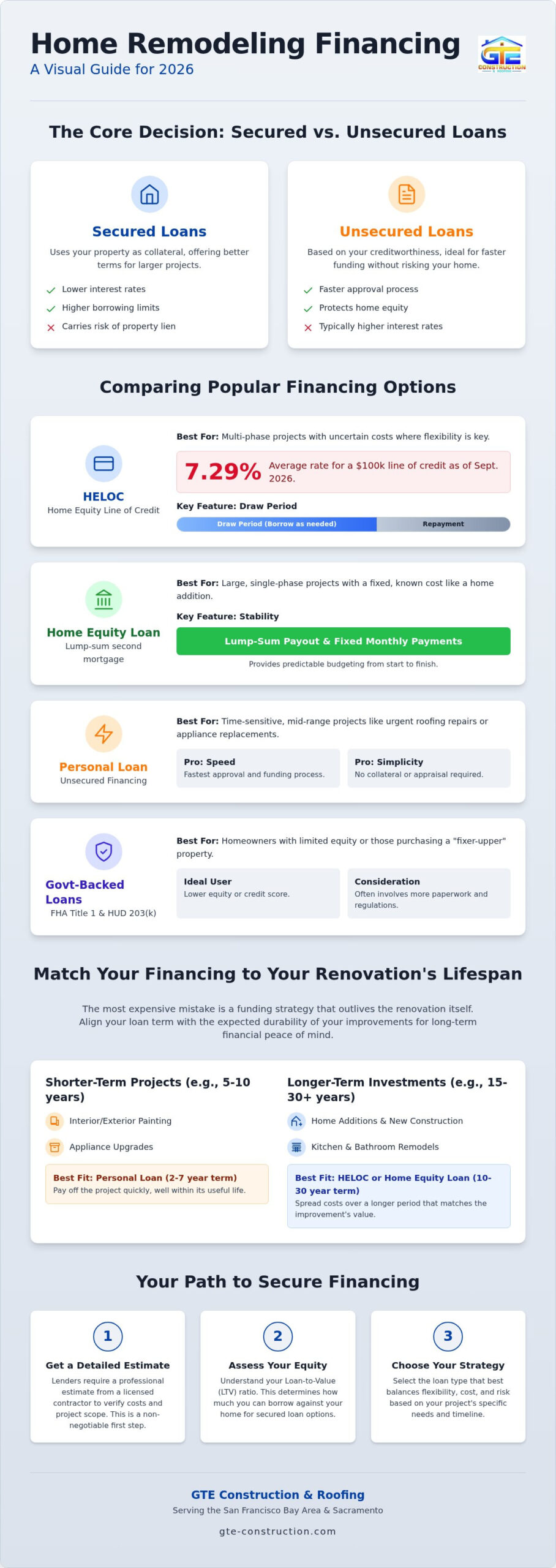
The primary distinction between different home remodeling financing options lies in the presence of collateral. Secured loans use the property itself as a guarantee, which typically results in lower interest rates. Homeowners can find a comprehensive home equity loan definition to understand how these instruments function as a second mortgage. While secured paths offer higher borrowing limits, they carry the risk of a lien against the property. Conversely, unsecured personal loans are gaining popularity for mid-range remodels because they don’t require collateral. This path offers a faster approval process and protects the home’s equity, making it a supportive choice for projects that require immediate execution.
Leveraging Home Equity: HELOCs and Home Equity Loans
For homeowners in Alameda and Contra Costa counties, sustained property appreciation has created a significant reservoir of wealth. This equity serves as one of the most powerful home remodeling financing options available in 2026. Unlike unsecured debt, equity-based loans leverage the home’s value to secure more favorable interest rates, often making them the most cost-effective path for high-value investments like home additions, new home construction, or a custom project with a pool builder napa ca to upgrade your property. A key advantage for many Californians is the potential tax deductibility of the interest, provided the funds are used for capital improvements that increase the property’s value or prolong its useful life.
A Home Equity Line of Credit (HELOC) functions as a revolving credit source secured by your property. It provides a dedicated draw period where you only borrow what you need as the project reaches specific milestones. This flexibility perfectly mirrors the methodical flow of a complex build. You draw funds for the initial demolition, pay for the expert framing, and only then move to the expensive finishing touches. In the September 2026 economic climate, managing variable interest rates, which averaged 7.29 percent for a 100,000 dollar line of credit, requires a disciplined approach. This structure is particularly effective when working with a whole house renovation contractor, as it allows for budget adjustments if the architectural scope evolves during the construction process.
Fixed-Rate Home Equity Loans for Predictable Budgeting
When the project scope is clearly defined from the outset, such as a specific kitchen or bathroom remodeling project, a lump-sum home equity loan offers superior predictability. Because these loans carry a fixed interest rate, your monthly payments remain constant throughout the life of the loan. This stability is a significant benefit for homeowners who prefer a locked-in budget and protection against market volatility. However, choosing between a HELOC vs. home equity loan involves more than just a rate comparison. Home equity loans often have higher closing costs than HELOCs but provide peace of mind against future rate hikes.
To avoid the risk of under-borrowing, it’s essential to start with a precise, professional quote. A seasoned expert can identify hidden costs early, ensuring your financing covers every detail from structural permits to final finishes. If you are ready to explore how your home’s equity can fund your vision, you might consult a licensed local expert to discuss your project’s specific requirements and architectural nuances.
Personal Loans and Unsecured Financing for Immediate Needs
While equity-based lending offers lower rates for massive renovations, unsecured home remodeling financing options provide a streamlined alternative that doesn’t require your home as collateral. These personal home improvement loans are defined by their agility and lack of property-backed risk. Because the lender doesn’t place a lien on your residence, the application process is significantly shorter. You don’t have to wait for a professional appraisal or a lengthy title search, which can often take weeks in busy California markets. This speed provides a sense of security for homeowners who need to address pressing maintenance issues before they escalate into structural failures.
The primary trade-off for this convenience is a higher interest rate compared to secured loans. As of mid-2026, the average personal loan interest rate was approximately 12.28 percent. However, lenders offer a wide spectrum of APRs, ranging from 6.49 percent to as high as 35.99 percent, depending heavily on your credit profile. For borrowers with excellent credit, the lack of closing fees and the rapid funding timeline often outweigh the higher interest costs, especially for mid-range projects where the total interest paid over a shorter term remains manageable.
When Speed is the Priority: Roofing and Gutter Repairs
Urgent structural concerns, such as storm-damaged gutters or the need for precision roof repair services, require immediate intervention to protect the property’s longevity. Waiting for an equity-based loan to clear can lead to secondary damage from water intrusion or mold. Unsecured loans allow you to act as a responsible steward of your home by securing funds in as little as 24 to 48 hours. In the 2026 market, these loans typically offer terms up to seven years with maximum amounts reaching 100,000 dollars, providing enough capital for high-quality materials and expert installation without the stress of property-backed debt.
Credit Cards and Promotional Financing
For minor cosmetic updates or finishing touches, some homeowners utilize credit cards to manage smaller expenses. Strategic use of a 0% APR introductory period can be effective for purchasing high-end fixtures or appliances, provided you have a disciplined plan to clear the balance before the promotional window closes. You must remain vigilant regarding “deferred interest” plans, which can retroactively apply high interest rates if the full amount isn’t paid on time. Rewards cards can offer a modest return on your investment through cash back or travel points, but this approach is only advisable for well-defined, low-cost projects that won’t strain your monthly budget.
Government-Backed Loans and Specialized California Programs
Government-backed home remodeling financing options provide a vital safety net for projects that require significant structural intervention or for homeowners who haven’t yet built substantial equity. These programs, such as those offered by the Federal Housing Administration (FHA), are designed to promote property stability and community revitalization. Because the government insures these loans, lenders can often offer more accessible terms to those who might not qualify for traditional private financing. A non-negotiable requirement for these programs is the involvement of a licensed general contractor. This mandate ensures that every dollar spent contributes to the long-term safety and architectural integrity of the residence.
For those looking to purchase and renovate a property in the Sacramento or Bay Area markets, the HUD 203(k) Rehabilitation Mortgage is a premier tool. In 2026, the FHA loan ceiling for high-cost areas has reached 1,249,125 dollars, making these loans viable even in California’s competitive real estate landscape. The Standard 203(k) is designed for projects exceeding 5,000 dollars, including structural changes like home additions or new roofing. This program allows you to bundle the purchase price and renovation costs into a single mortgage with a down payment as low as 3.5 percent for those with a credit score of 580 or higher.
FHA Title 1: Financing Without Equity
The FHA Title 1 Property Improvement Loan is specifically tailored for homeowners who need to make essential repairs but lack the equity required for a HELOC. For a single-family home, you can borrow up to 25,000 dollars without needing to use your home as collateral if the loan is under 7,500 dollars. For multi-unit properties, the limit increases to 12,000 dollars per unit, with a maximum cap of 60,000 dollars. To qualify, the property must have been occupied for at least 90 days. In 2026, interest rates on Title 1 loans remain fixed and are set by FHA-approved lenders according to current market benchmarks, ensuring your monthly payments stay predictable throughout the term.
Energy Efficiency and Structural Integrity Incentives
California homeowners have access to specialized state-level programs like GoGreen Home and local seismic retrofitting grants. These initiatives focus on the intersection of environmental responsibility and structural resilience. For instance, water conservation upgrades often integrate seamlessly with erosion control landscaping, protecting your property from the seasonal water damage common in the SF Bay Area. Navigating the technical paperwork for these incentives requires a disciplined partner who understands local building codes. If you are ready to modernize your home’s efficiency, you can contact GTE Construction to ensure your project meets all state-mandated standards for government-backed funding.
Choosing the Right Financing for Your GTE Construction Project
Selecting the ideal funding source requires a balance between the scale of your vision and the structural lifespan of the work performed. A strategic approach ensures that you aren’t paying for a cosmetic update long after the materials have reached the end of their aesthetic relevance. For the sophisticated homeowner, the goal is to achieve a result that offers both immediate luxury and long-term peace of mind. By matching specific home remodeling financing options to the unique requirements of your project, you protect your property’s equity while ensuring the construction process remains steady and organized. If you are looking for a firm that mirrors this commitment to quality and strategic planning in other markets, you can discover Precision Innovative Construction LLC for premier remodeling and additions in the Raleigh-Durham area.
Matching Financing to Project Type
The duration and cost of your project are the primary drivers in selecting a loan. For immediate needs like roofing or gutter repair, unsecured personal loans offer the speed required to prevent further structural decay. When you move into high-value interior transformations, such as kitchen and bathroom remodeling, a HELOC or a cash-out refinance often provides the necessary capital at a lower interest rate. For those embarking on the custom home building process, a construction-to-permanent loan is the standard choice. This specialized product covers the costs of the build phase and then converts into a traditional mortgage once the home is ready for occupancy.
The GTE Advantage: Professionalism and Precision
Lenders prioritize stability and competence when approving substantial renovation loans. As a licensed general contractor serving the SF Bay Area and Sacramento, GTE Construction & Roofing provides the meticulous documentation that banks require to verify a project’s viability. Our disciplined home renovation project management ensures that every dollar of your loan is spent efficiently, following a logical progression from site preparation to the final inspection. This thoroughness not only builds trust with your financial institution but also guarantees that the craftsmanship matches the high standards of the materials selected.
Before you finalize your funding, consider this essential checklist to ensure the safest financial path:
- Verify the APR: Look beyond the base interest rate to understand the total cost, including all fees and points.
- Check for Prepayment Penalties: Ensure you have the flexibility to pay off the loan early if your financial situation changes.
- Assess the Monthly Impact: Confirm that the new payment fits comfortably within your existing budget without causing stress.
- Review the Draw Schedule: For HELOCs or construction loans, ensure the lender’s release of funds aligns with the contractor’s project milestones.
The first step toward a successful renovation is a clear, professional estimate. By understanding the full architectural scope and costs upfront, you can apply for financing with the confidence that your project is built on a foundation of expert knowledge and local experience. Requesting a professional estimate for your 2026 project allows you to move forward with a partner dedicated to exceeding standard expectations.
Securing the Future of Your Home with Confidence
A successful renovation begins with a financial strategy that respects both your vision and your property’s long-term integrity. By aligning your chosen home remodeling financing options with the specific scope of your project, you ensure that your investment provides lasting value without compromising your monthly stability. Whether you are utilizing a flexible HELOC for a multi-phase addition or a streamlined personal loan for urgent repairs, the most critical factor remains the quality of the execution. Lenders and homeowners alike find peace of mind when a project is backed by meticulous planning and professional oversight.
As a Licensed California General Contractor serving San Francisco, Sacramento, and the East Bay, GTE Construction & Roofing is dedicated to maintaining the highest standards of craftsmanship. We provide the detailed documentation and expert management required to satisfy modern lending requirements, ensuring your project is handled with the reliability an A+ rated professional provides. When you are ready to take the next step in your home’s evolution, we invite you to Request a Professional Remodeling Estimate from GTE Construction. Your home is your most significant asset, and we look forward to helping you build a legacy of durability and beauty.
Frequently Asked Questions
What is the best credit score needed for a home improvement loan in 2026?
A credit score of at least 620 is typically required for conventional home improvement loans, while FHA 203(k) programs allow scores as low as 580 with a larger down payment. Higher scores, particularly those above 740, remain essential for securing the most competitive interest rates in the 2026 market. Lenders analyze your credit history to ensure you can manage the monthly impact on your budget. Maintaining a strong score provides you with the widest range of home remodeling financing options for your project.
Can I finance a home remodel if I just bought the house and have no equity?
You can finance a renovation without equity by utilizing unsecured personal loans or the FHA Title 1 Property Improvement Loan program. These options don’t require collateral, making them accessible to new homeowners in the SF Bay Area who haven’t yet seen significant property appreciation. While interest rates are generally higher than equity-based loans, they allow you to address immediate needs like kitchen remodeling or bathroom updates shortly after your home purchase.
Is the interest on a home improvement loan tax-deductible in California?
Interest paid on home equity loans and HELOCs is often tax-deductible in California if the funds are used specifically to buy, build, or substantially improve the home. These “capital improvements” must add value to the property or prolong its useful life, such as a new roof installation or a structural home addition. You should always consult a qualified tax professional to confirm how current 2026 state and federal regulations apply to your specific financial situation.
How long does it typically take to get approved for a HELOC?
Approval for a HELOC typically takes between two and six weeks because the process requires a formal property appraisal and a detailed title search. This methodical timeline ensures the lender has an accurate understanding of your home’s current market value in regions like Alameda or Contra Costa County. If you require faster funding for urgent roofing repair, an unsecured personal loan can often be approved and funded within 24 to 48 hours.
What happens if the construction costs exceed my loan amount?
If costs exceed your loan amount, you may need to cover the difference with personal cash reserves or apply for a secondary unsecured loan. GTE Construction mitigates this risk through a disciplined estimating process that identifies potential structural hurdles before work begins. Lenders prefer working with licensed professionals who provide transparent project management, as this precision ensures the loan amount remains aligned with the actual construction requirements from start to finish.
Can I use a personal loan for a home addition in Sacramento?
You can use a personal loan for a home addition in Sacramento, though these loans are usually capped at 100,000 dollars. For a complex or large-scale addition, the project costs might exceed the limits of an unsecured loan. In such cases, leveraging your home’s equity through a HELOC or a standard home equity loan provides a more robust funding source. This approach allows for the high-quality materials and craftsmanship required for structural longevity.
Are there specific financing options for roof replacement after storm damage?
Homeowners often use personal loans for immediate roof replacement after storm damage because they offer the fastest funding timeline. While insurance may cover a portion of the costs, home remodeling financing options like unsecured loans bridge the gap for upgrades or deductibles. GTE Construction specializes in precision roofing repair and new installations, providing the professional documentation necessary to satisfy both insurance adjusters and lenders during the recovery process.
How do I choose between a home equity loan and a cash-out refinance?
Choosing between a home equity loan and a cash-out refinance depends largely on the interest rate of your existing mortgage. If your current rate is significantly lower than 2026 market averages, a home equity loan allows you to keep that rate while adding a second fixed-rate payment. Conversely, a cash-out refinance replaces your entire mortgage with a new loan. This choice impacts your long-term fiscal health and should align with your overall equity goals.