Fewer seams don’t make a gutter system leak-proof. Seamless gutter installation reduces the number of joints along the roofline, but connections at corners and downspout outlets still need careful attention. If you’re weighing seamless gutters for your home, focus on how the runs will fit the roofline, where water will drain, and what needs to be in place for secure attachment.
The work follows a practical sequence: installers assess and measure the roofline, form continuous gutter lengths, then mount and connect them so water flows toward downspouts. Compared with sectional gutters, there are fewer joints along straight runs, but sound fitting and a clear drainage route still matter.
This guide explains what “seamless” means, where connections remain, and what the system can and can’t do. You’ll also find steps to prepare for installation, including noting fascia concerns and clearing access around the house. GTE Construction & Roofing provides residential gutter installation and repair in San Francisco, Sacramento, Alameda County, and Contra Costa County, with planning tailored to the property and project.
Key Takeaways
- Seamless gutters reduce joints along straight runs, but connections at corners and downspout outlets still need attention.
- Accurate roofline measurements help shape a system to your home and avoid unnecessary joints during seamless gutter installation.
- Before the project, note existing downspout locations, drainage concerns, and access needs around your home.
- Sharing relevant roof or exterior project details helps tailor gutter planning to your property.
- GTE Construction & Roofing provides residential gutter installation and roofing services in San Francisco, Sacramento, Alameda County, and Contra Costa County.
What seamless gutter installation means for your home
Seamless gutters are continuous, custom-formed runs with fewer joints along straight sections of a roofline. Rather than joining several short pieces end to end, an installer forms a length to fit a measured stretch of the home. “Seamless” describes those long runs, not every part of the system.
Gutters catch rainwater as it flows off the roof and channel it toward downspouts, which carry runoff down from the roofline. The parts must work together: each gutter run needs to meet corners, end points, and downspout outlets to create a drainage path. Those transitions still require connections, even when the straight sections are continuous.
A seamless gutter is one way to collect roof runoff, but the design is only part of a well-planned system. The roofline’s shape, the route water should take, and the locations where runs meet all inform how the gutters fit the home.
How seamless gutters differ from sectional gutters
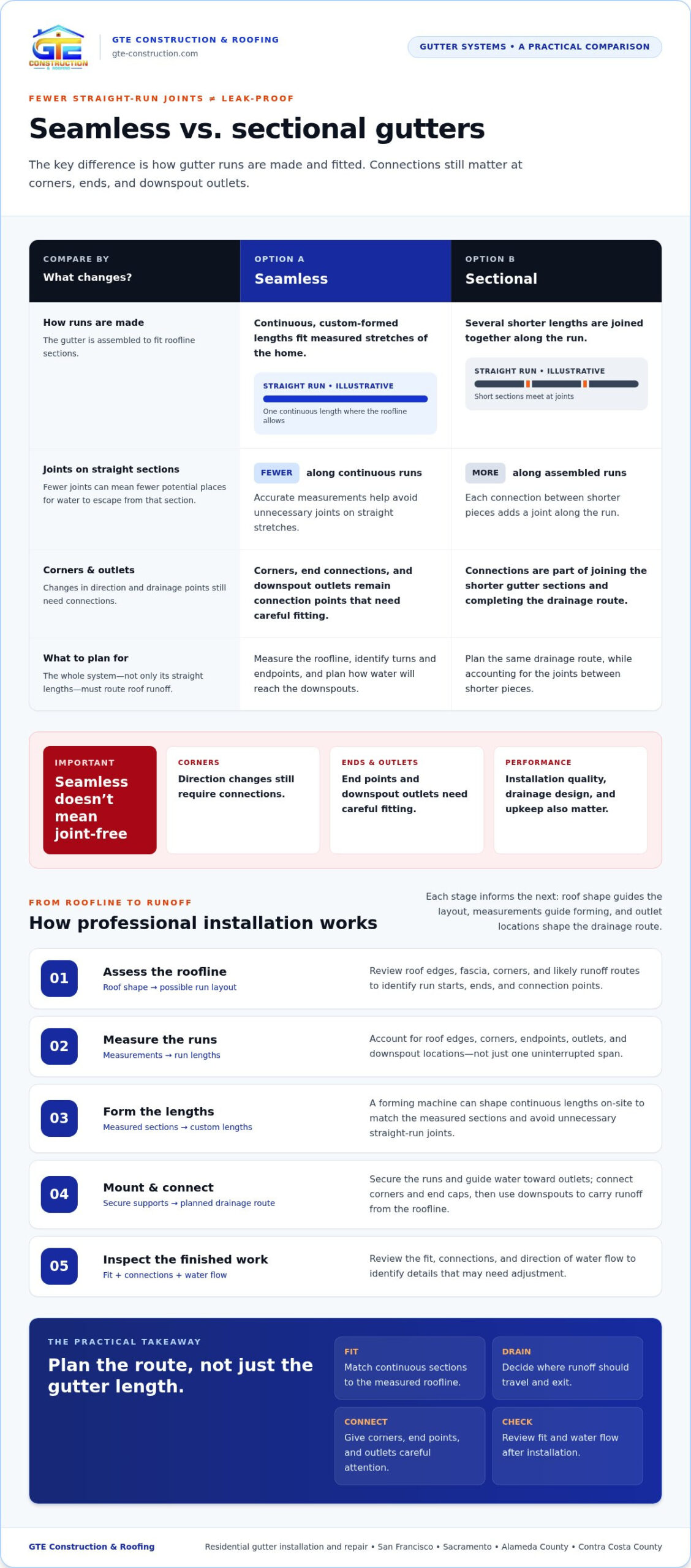
Sectional gutters are assembled from shorter lengths connected at intervals. Each connection creates another joint along the run. Seamless construction reduces those joints by forming a length to fit a measured section of roofline. For example, a long, uninterrupted eave can often use one continuous piece instead of several sections joined together.
Fewer joints along a straight run mean fewer potential places for water to escape from that section, but they don’t guarantee leak prevention. The main difference is how the gutter is made and fitted. A roofline with turns or separate edges still needs connecting details, so planning those transitions is part of designing a suitable layout.
What seamless construction does not guarantee
Seamless gutters aren’t completely joint-free or leak-proof. Corners, end connections, and outlets where downspouts meet the gutter remain important connection points. These details need careful fitting because a continuous straight run cannot account for every change in direction or drainage point on a home.
Performance also depends on more than the number of joints. Installation quality, drainage design, and upkeep all play a role in how the system handles roof runoff. Debris or a poorly planned water route can affect drainage, whether the straight runs are seamless or sectional.
So the useful question isn’t whether seamless gutters eliminate seams. It’s how the continuous sections will fit the roofline, where connections will sit, and how runoff will reach the downspouts. A measured, property-specific plan makes those details clear before installation begins.
How professional seamless gutter installation works
Professional seamless gutter installation follows a measured sequence, from assessing the roofline to reviewing how the finished system directs water. Each stage informs the next: roof shape determines the run layout, measurements guide fabrication, and outlet locations help establish the drainage route. Planning also helps identify fascia concerns and access needs before work begins.
In short, installers assess and measure the roofline, form the gutter runs, mount and connect the system, then inspect its fit and drainage.
- Assess the roofline. The installer reviews the roof edges, fascia, corners, and likely routes for runoff. This helps establish where each run can begin and end, and where connections will be needed.
- Measure the runs. Measurements of the roof edges help determine the lengths to form. The layout also accounts for corners, end points, outlets, and downspout locations, rather than treating the roofline as one uninterrupted span.
- Form the gutter lengths. A forming machine can shape continuous lengths on-site to match the measured sections. Accurate measurements help the lengths fit their intended locations and avoid unnecessary joints along straight runs.
- Mount and connect the system. Installers secure the gutters to the roofline with suitable supports and arrange the runs to guide water toward the outlets. Corners, end caps, and downspouts connect the separate parts of the drainage route.
- Inspect the finished work. A final review checks the fit, connections, and direction of water flow, helping identify details that may need adjustment.
Measuring and forming custom gutter runs
Measurement involves more than recording the length of an eave. The installer identifies where the roofline changes direction, where a run should end, and where runoff needs to enter a downspout. These points shape the fabrication plan. A straight edge may allow one continuous length, while a corner or roofline break calls for a separate run and a joined connection. On-site forming then produces lengths for the measured layout instead of relying on a series of standard short sections. Sharing known roof or exterior concerns during planning helps keep the proposed layout grounded in the home’s actual conditions.
Mounting, connecting, and checking the system
Once formed, each run must be secured so it stays in position and directs water toward its outlet. The intended flow path matters: the gutter’s alignment and slope guide runoff toward the outlets rather than allowing it to collect in the wrong area. Corner pieces and end caps finish the run, while downspouts carry water away from the roof edge. The Rain Gutter Association offers industry information related to gutter installation practices. A final visual or water-flow check helps assess the completed fit and connections.
GTE Construction & Roofing provides residential gutter installation alongside roofing services in San Francisco, Sacramento, Alameda County, and Contra Costa County. Homeowners planning residential gutter installation can share relevant roof and exterior details to help shape the project plan.
Are seamless gutters leak-proof? Compare benefits and limitations
No. Seamless gutters are not completely joint-free, and they shouldn’t be described as leak-proof. Their main distinction is fewer joints along straight runs, which can reduce the number of potential leak points in those sections. Connections remain where the layout turns, ends, or directs water into a downspout, and each needs careful fitting.
That difference can also affect the roofline’s appearance. A continuous run has fewer visible breaks than multiple joined sections, but appearance alone doesn’t determine how well a gutter handles runoff. Roof layout, secure fitting, outlet placement, and upkeep all influence drainage. The comparison below focuses on construction and practical trade-offs, not a promise of performance.
Construction: Sectional gutters are assembled from shorter pieces; seamless gutters are formed in longer runs to fit measured roof edges.
Joints: Sectional systems have connections at intervals along their runs. Seamless systems reduce these straight-run joints, but still need joined corners, ends, and outlets.
Appearance: Longer continuous lengths create fewer visible breaks along a roof edge. Sectional lengths show more connections between pieces.
Practical limitation: Neither construction type removes the need for sound fitting, a drainage plan, and upkeep. Seamless construction doesn’t prevent every leak or drainage issue.
Where leaks can still develop
Potential weak points include corners, outlets, end caps, and downspout connections, where separate components meet. Water flow can also be affected by blockages, damage, or a route that doesn’t direct runoff properly. These factors matter beyond the straight gutter lengths, so fewer joints shouldn’t be mistaken for immunity from leaks. The design and condition of the whole drainage path count.
When the seamless option may suit a project
Seamless gutters may suit a home with long roof edges, a preference for fewer visible joints, or a layout that benefits from custom-formed runs. That doesn’t make them the right choice for every roof. Roofline shape, corners, outlet positions, and drainage requirements determine how the system needs to be arranged and connected.
For homeowners considering seamless gutter installation, start with the property rather than a blanket claim that one design is always better. Consider which roof edges may accommodate continuous runs, where connections will remain, and how runoff should reach the downspouts. Regular upkeep is also part of caring for either type of system. Assessing these details helps set realistic expectations and supports a plan suited to the home.
How to prepare for installation in the Bay Area or Sacramento
A little preparation helps make a gutter project more focused. Before seamless gutter installation, note what you’ve observed around the roofline and yard, then share those details during project planning. You don’t need to measure the roof yourself or diagnose a drainage issue. Your observations can help guide an assessment of the roof edges, existing gutters, and where runoff goes.
Information to gather before the project
Walk around the home from the ground and note visible features or concerns. If possible, describe what happens during or after rain, such as water leaving a particular roof edge or pooling near part of the property. These observations provide useful context without requiring you to determine the cause.
- Roof edges: Note the sides of the home with gutters, visible corners, changes in roofline, or sections that appear to lack coverage.
- Existing drainage: Record where downspouts are located and where water currently exits them. Mention areas where runoff seems to collect or flow toward the home.
- Gutter condition: Point out visible sagging, separation, damage, overflow, or debris, if you’ve noticed it from a safe vantage point.
- Access needs: Identify features such as narrow side paths, gates, landscaping, or other obstacles around the exterior that could affect access to the roofline.
- Related work: Share recent or planned roof and exterior projects, along with drainage concerns you want considered.
Roof runoff and the surrounding property are connected: water gathered at the eaves needs an appropriate route away from the building and into the landscape. GTE’s erosion control landscaping guide offers related context on how water movement and site conditions can affect a home’s exterior. Sharing what you’ve observed helps frame the wider drainage picture.
Local requirements and related roof work
GTE Construction & Roofing provides residential gutter installation and roofing services in San Francisco, Sacramento, Alameda County, and Contra Costa County. Permit requirements for construction work can depend on the project and its jurisdiction, so don’t assume one city’s guidance applies across the region. For permit or code questions, check current information from the relevant local building department or authority before work begins.
If gutter work is part of a roofing project, mention that during planning so the roof and drainage work can be considered together. GTE’s new roof installation guide provides additional context for homeowners considering roof work alongside exterior improvements.
Use your notes to start a focused discussion about the home’s roofline, existing downspouts, access, and runoff concerns. To plan residential gutter installation around your property, share the details you’ve gathered with GTE Construction & Roofing.
Plan seamless gutter installation with GTE Construction & Roofing
Planning starts with the home, not a one-size-fits-all layout. GTE Construction & Roofing provides residential gutter installation alongside roofing services. A gutter plan should account for the property’s roofline and drainage needs, including how runs fit the roof edges and where runoff should travel.
GTE serves homeowners in San Francisco, Sacramento, Alameda County, and Contra Costa County. Sharing what you’ve noticed around the roof and exterior helps put the project in context, whether you’re replacing existing gutters or coordinating gutter work with roofing.
What a project-focused conversation should cover
You don’t need technical measurements or a finished design to get started. Describe the home, the visible roof edges, existing gutters and downspouts, and any concerns about water flow. These observations help frame the installation requirements and identify which parts of the property need attention.
- Describe where gutters currently run and where downspouts carry water.
- Point out visible roofline changes, corners, or areas that seem difficult to access.
- Explain where you’ve noticed overflow, pooling, or runoff moving toward the home.
- Share relevant roof repairs, replacement plans, or other exterior work.
It’s helpful to distinguish what you’ve observed from what you’re unsure about. For example, you might say that water collects near a walkway after rain without trying to determine whether the gutter, downspout, or surrounding grade is responsible. That gives the project discussion a clear starting point while leaving room to consider how the roofline and drainage fit together.
A clear next step for local homeowners
Questions about continuous gutter runs, remaining connection points, or how roof work relates to drainage are all useful for planning. GTE Construction & Roofing provides gutter installation and roofing services for homeowners in San Francisco, Sacramento, Alameda County, and Contra Costa County. If the work may coincide with roofing, mention that early so both parts of the exterior project can be considered together.
For local homeowners, a focused conversation can help clarify the project’s requirements and next steps. Share your observations and questions with GTE Construction & Roofing when you’re ready to discuss your gutter installation project.
Discuss your gutter installation project with GTE Construction & Roofing.
Take the next step with a clear plan
A well-planned gutter project begins with a practical question: what do you want the system to address at your home? You may be preparing for broader exterior work, responding to a concern about runoff, or considering custom-formed gutters for a new project. Identifying your priorities gives the conversation a useful starting point and keeps decisions focused on the property, rather than broad promises about any one gutter style.
As you consider seamless gutter installation, bring questions about the roofline, drainage, and how the work could fit with other exterior plans. You don’t need to have every detail decided before taking that step. A focused discussion can help clarify the project and what planning it calls for.
GTE Construction & Roofing provides residential gutter installation and repair, as well as roofing installation and repair. If you’re ready to discuss your home’s needs, discuss your gutter installation project with GTE Construction & Roofing. Start with what you’ve noticed and what you hope to accomplish. A clear conversation is a confident first step toward planning the work.
Frequently Asked Questions
What is seamless gutter installation?
Seamless gutter installation fits custom-length gutter runs to the roof edges, rather than assembling each straight stretch from short sections joined together. The distinction is how the lengths are made and arranged, not a different way rain behaves. Long straight sections have fewer intermediate joints, while changes in direction and outlet points still need connections. The roofline’s shape determines where the runs are divided.
Are seamless gutters completely leak-proof?
No. A continuous run has fewer joints along its length, but corners, end caps, and downspout outlets still rely on connections. After heavy rain, note where water overflows or escapes and whether the location is near a connection. That observation can help guide an inspection, but it doesn’t identify the cause by itself. Debris, damage, and the drainage layout may also affect how the system performs.
How are seamless gutters made to fit a house?
Installers measure the roof edges and plan the runs around corners, ends, and outlet locations. A forming machine shapes continuous lengths to suit those measurements, often at the property. The roofline determines where a run can remain continuous and where a connection is needed. For example, two roof edges meeting at a corner generally require separate lengths joined at that transition, rather than one straight piece bent to fit.
Can seamless gutters be installed on any roof?
Not every roofline or attachment area is automatically suitable for the same layout. The shape and length of the roof edges, corners, drainage needs, and condition of the fascia all inform the plan. If the fascia is damaged or deteriorated, that condition may need attention before new gutters can be securely attached. A property-specific assessment helps determine how the system can fit the home and where its connections will sit.
How long does seamless gutter installation take?
There isn’t one reliable duration for every home. The project’s scope can depend on the roofline’s length and complexity, the number of corners and outlets, access around the house, and whether fascia repairs or related roofing work are involved. Sharing these details during planning helps clarify the work required. GTE Construction & Roofing provides residential gutter installation in San Francisco, Sacramento, Alameda County, and Contra Costa County.
Do seamless gutters need regular maintenance?
Yes. Seamless construction reduces joints along straight runs, but it doesn’t prevent leaves and other debris from collecting in the gutter or outlets. Periodically check that visible runs are clear and that downspouts can carry water away. Pay attention after storms or seasonal leaf fall, especially if you’ve noticed overflow before. If a gutter is difficult or unsafe to reach, don’t climb or lean from an unstable position to inspect it.
Do I need a permit for gutter installation in California?
Permit requirements can depend on the project and the local jurisdiction, so there isn’t a single answer for every California home. Before work begins, check current guidance with the building department or relevant authority for your location. Homeowners in San Francisco, Sacramento, Alameda County, and Contra Costa County should use the guidance that applies to their specific city or county rather than assuming requirements are identical across the region.