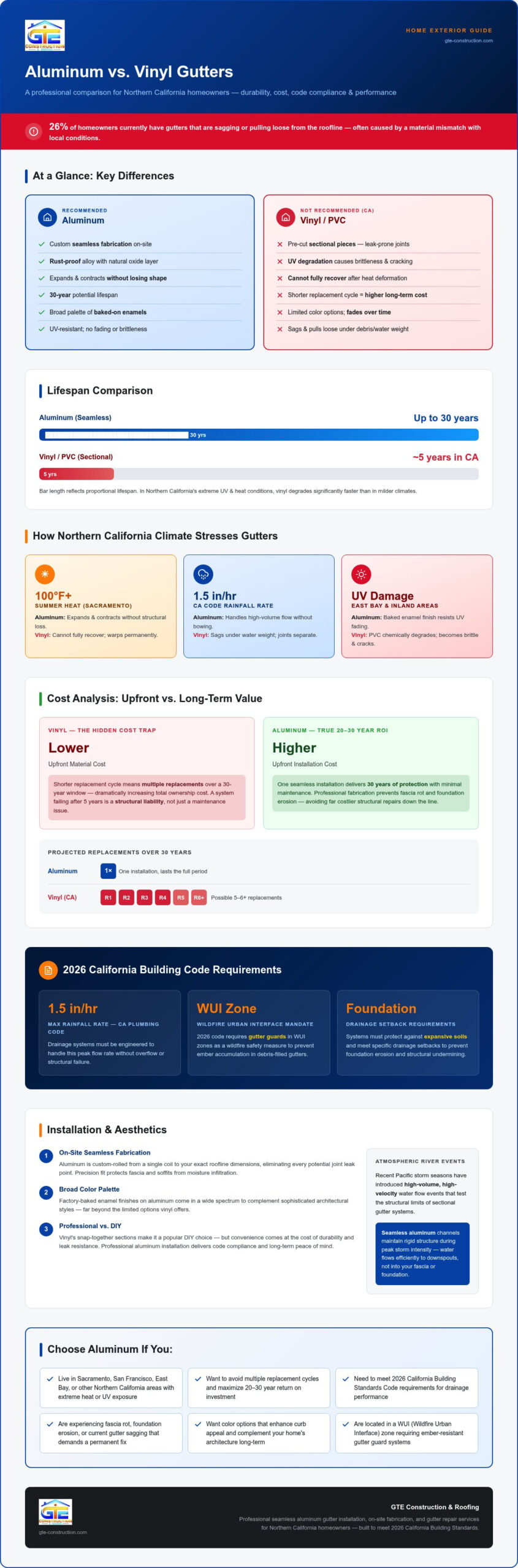
Nearly 26 percent of homeowners report that their gutters are currently sagging or pulling loose from the roofline, a statistic that often points to a mismatch between material choice and local environmental demands. When you’re facing leaking joints or the threat of fascia rot, the comparison of aluminum vs vinyl gutters becomes more than just a matter of initial cost; it’s a decision about the long-term structural integrity of your property. We recognize that selecting a drainage system is a significant step in home maintenance, particularly as the 2026 California Building Standards Code introduces stricter requirements for residential exteriors.
You deserve a home that remains protected against Northern California’s intense summer heat and heavy winter rains. This guide provides a detailed look at the durability and performance of each material to help you make a professional-grade decision. We’ll examine how these systems handle our unique climate, ensuring your foundation stays secure and your curb appeal remains sharp for years to come. Precision in your choice today prevents expensive repairs tomorrow.
Key Takeaways
- Understand the fundamental differences between aluminum vs vinyl gutters, specifically how seamless metal systems outperform sectional plastic in preventing leaks and structural rot.
- Discover why Northern California’s extreme temperature fluctuations and intense UV exposure cause vinyl to become brittle, while aluminum maintains its shape and integrity.
- Learn why the lower upfront price of vinyl often leads to higher long-term expenses due to a shorter replacement cycle compared to the 30-year potential of aluminum.
- Identify critical 2026 California Building Code requirements, including wildfire safety mandates for gutter guards in WUI zones and specific drainage setbacks for foundation protection.
- See how professional on-site fabrication ensures a precise fit that matches your home’s architecture while safeguarding your fascia and soffits from moisture damage.
Aluminum vs. Vinyl Gutters: Understanding the Basics
Choosing between aluminum vs vinyl gutters is a decision that dictates the safety of your home’s foundation for decades. While both materials serve the same primary function, their chemical compositions and installation methods create vastly different outcomes for Northern California properties. Aluminum systems consist of a lightweight, rust-proof metal alloy that we typically fabricate on-site to match the exact dimensions of your roofline. In contrast, vinyl gutters are made from polyvinyl chloride (PVC) and are sold in pre-cut, sectional pieces designed for quick, temporary assembly. Understanding these fundamental differences is the first step toward a reliable exterior drainage strategy.
The Rise of Seamless Aluminum in Northern California
Homeowners in San Francisco and Sacramento are increasingly moving away from sectional plastic because of the region’s shifting weather patterns. The “Atmospheric River” events of recent seasons have tested the limits of standard drainage, demanding a material that can withstand high-volume, high-velocity water flow without bowing or detaching. Seamless aluminum refers to a continuous gutter run that is custom-rolled from a single coil of metal to eliminate the leak-prone joints found in traditional sectional systems. By utilizing on-site fabrication, we create a single, unbroken channel that maintains its structural rigidity during the peak intensity of a Pacific storm. This precision ensures that water moves efficiently to the downspouts rather than pooling in sagging sections.
The Appeal and Pitfalls of Vinyl Systems
Vinyl systems often attract attention due to their lower upfront material costs and the convenience they offer for small-scale DIY projects. Because they are lightweight and snap together, they are easy to transport in a standard vehicle. However, the “Plastic Problem” remains a significant hurdle for California residents. Intense UV exposure in areas like the East Bay causes PVC to undergo chemical degradation, leading the material to become brittle and eventually crack under pressure. Additionally, vinyl color options are typically limited to a few basic shades. Factory-finished aluminum offers a broader palette of baked-on enamels designed to complement sophisticated architectural styles while resisting the fading common in plastic alternatives.
Durability and Performance: How Materials React to California Weather
Northern California’s environmental conditions demand more than just basic water diversion; they require materials that maintain structural integrity under extreme stress. In Sacramento, where summer temperatures frequently exceed 100°F before dropping significantly at night, the physical demands on your drainage system are relentless. When evaluating aluminum vs vinyl gutters, the primary differentiator is how each material responds to this thermal cycling. Aluminum alloys are engineered to expand and contract without losing their foundational strength, whereas plastic alternatives often struggle to return to their original shape after intense heat exposure.
Beyond temperature shifts, the weight of standing water or seasonal debris tests the limits of your gutter’s hangers and fasteners. Aluminum’s natural oxide layer provides a permanent defense against corrosion, ensuring the metal doesn’t weaken or thin over time. This chemical stability allows the system to support significant weight during heavy downpours without the bowing or pulling away from the fascia that frequently occurs with sectional vinyl. If you’re concerned about how your current system is performing under these conditions, a professional gutter repair assessment can identify early signs of material fatigue before they lead to structural rot.
The Brittle Factor: Why Vinyl Fails in the Sun
The chemical breakdown of PVC under constant UV radiation is a significant issue for homes in Alameda and Contra Costa counties. Over just a few seasons, the sun’s rays strip the plasticizers from vinyl gutters, leaving them brittle and prone to failure. This “dry-rot” effect often targets the fastener points where the gutters meet the home. When the material loses its flexibility, it can no longer absorb the vibrations of high winds or the weight of a ladder during routine maintenance. This leads to a high risk of the material shattering, which turns a simple cleaning task into a complete system replacement.
Aluminum’s Structural Resilience
Professional-grade aluminum installation relies on a .032-inch gauge thickness, which is the industry benchmark for 2026. This specific thickness provides the ideal balance of lightweight efficiency and impact resistance. Unlike vinyl, which can sag and lose its “pitch” (the slight angle required to move water toward downspouts), aluminum maintains its precise alignment for decades. Whether facing falling branches or the rare California hail storm, metal systems resist the denting and cracking that compromise the functionality of thinner, consumer-grade materials. This structural resilience is what ultimately protects your fascia and foundation from the cascading water caused by system failure, a standard of durability also emphasized by experienced contractors like Advanced Roofing.
Cost Analysis: Upfront Pricing vs. Long-Term Value
Comparing the financial commitment of aluminum vs vinyl gutters requires looking past the initial receipt to understand the total cost of ownership. Vinyl sections represent the lowest entry point for a drainage project, making them attractive for immediate budget concerns. However, this initial savings is almost always offset by the “replacement cycle” common in our regional climate. While a professional aluminum system is engineered for a 20 to 30-year lifespan, vinyl typically requires full replacement every 10 to 15 years. For a homeowner in Sacramento or the East Bay, this means paying for labor and materials twice in the same timeframe it takes for an aluminum system to reach its mid-life point.
Real estate experts across Northern California frequently highlight that the aesthetic and functional reliability of seamless metal systems positively impacts property value. A sectional plastic system with visible seams and potential sagging is often viewed as a temporary fix during home inspections. In contrast, custom-rolled aluminum provides a clean, architectural finish that signals a well-maintained property. This professional appearance combines with superior moisture control to protect your home’s structural envelope from the roof down, ensuring that your investment remains secure against the elements.
Hidden Costs of Vinyl Gutters
The true expense of sectional systems often lies in the collateral damage caused by seam failure. Every joint in a vinyl run is a potential leak point that can allow water to seep behind the gutter and saturate the fascia boards. This constant moisture leads to wood rot and siding damage that far exceeds the initial savings of the plastic material. Over a five-year period, the cumulative cost of gutter repair for sectional systems can become a significant financial burden. When these leaks result in foundation erosion or destroyed landscaping, homeowners often find themselves requiring professional gutter repair services to mitigate the structural fallout.
The ROI of Seamless Aluminum
Investing in a high-capacity aluminum system offers a superior return through durability and reduced maintenance requirements. Because these runs are custom-fabricated on-site, they lack the joints that trap debris and cause heavy overflows. This streamlined design often reduces the complexity needed when selecting different types of gutter guards, as the system itself is more efficient at handling high-volume runoff from Atmospheric River events. By protecting the home against moisture-related energy loss and structural decay, aluminum serves as a dependable long-term insurance policy for your home’s exterior health.
Installation and Aesthetics: Matching Your Home’s Style
The visual impact of choosing between aluminum vs vinyl gutters is often the first thing a homeowner notices once the project is complete. While drainage is a functional necessity, the system should integrate seamlessly with your home’s architecture rather than looking like an afterthought. Professional aluminum installation utilizes on-site rolling machines to create continuous runs that match the exact length of your roofline. This method eliminates the bulky connectors and visible seams required by sectional vinyl, which often create a “choppy” appearance along the eaves. By choosing a material that allows for custom fabrication, you ensure that the clean lines of your home remain uninterrupted.
Precision extends to the mounting hardware used to secure the system. Older or cheaper installations often rely on visible spikes and ferrules that can loosen over time and mar the face of the gutter. We utilize hidden hangers that are fastened inside the gutter trough and screwed directly into the rafter tails. This internal mounting system provides superior structural support while remaining completely invisible from the ground. Whether you prefer the traditional look of K-Style gutters, the historic appeal of Half-Round profiles, or the modern edge of Box gutters, the mounting method should always prioritize both strength and a clean finish.
The Custom Fit Advantage
Eliminating the aesthetic flaws of sectional plastic is only one part of the professional advantage. Achieving the perfect “pitch” is a meticulous process; the gutter must slope slightly toward the downspouts to ensure water doesn’t pool, yet it must appear level to the naked eye to maintain curb appeal. This balance is difficult to strike with DIY-friendly vinyl kits that often sag between hanger points. Integrating your drainage system with a new roof installation allows for a cohesive exterior design where the drip edge, fascia, and gutters work together as a single, protective unit.
Curb Appeal in the Bay Area
High-end residential remodels in San Francisco and Sacramento almost exclusively favor metal systems for their sophisticated finish options. Factory-baked aluminum enamels are designed to resist “tiger striping,” those unsightly black streaks caused by pollutants and debris reacting with inferior paints. These modern finishes also resist the chalking and fading that typically plague vinyl after a few years of intense California sun. If you are ready to enhance your home’s exterior with a system designed for both beauty and longevity, you can schedule a professional gutter installation assessment with our team to explore custom color and profile options.
The GTE Approach: Why Professional Aluminum Installation Wins
At GTE Construction, we don’t treat gutter installation as a standalone task but as a critical element of your home’s total structural defense. Our systematic Action-Method-Result approach begins with a comprehensive audit of your building’s exterior health. By specifying high-gauge seamless aluminum rather than sectional plastic, we eliminate the structural vulnerabilities that typically end the aluminum vs vinyl gutters debate for serious homeowners. This methodology ensures that every linear foot of your drainage system is custom-contoured to your roofline, resulting in a permanent solution that safeguards your foundation and prevents moisture intrusion into your walls.
Our status as a licensed general contractor provides a level of expertise that goes beyond simple gutter hanging. We understand how drainage interacts with your entire building envelope, from the ventilation in your soffits to the integrity of your fascia boards. Serving our neighbors in San Francisco, Sacramento, and the East Bay, we bring local accountability to every project. We recognize that Northern California homes face unique challenges, including expansive soils that require precise water management to avoid costly foundation shifts. Our team ensures that every component is installed with the discipline and precision expected of a professional construction partner.
Total Home Protection
The transition from the roof edge to the gutter is where most exterior damage begins. We meticulously evaluate this area to ensure that the drip edge and flashing direct water into the trough without allowing any moisture to wick back toward the wood. This level of detail is standard in our larger whole house renovation projects, where we coordinate every exterior element for maximum longevity. A key part of this protection is professional downspout placement. We adhere to current standards, such as the 5-foot setback requirement from foundations on expansive soils, to ensure that once water leaves your roof, it doesn’t become a threat to your home’s lower levels. Pairing a properly engineered drainage system with erosion control landscaping creates a comprehensive roof-to-root water management strategy that protects your soil, foundation, and property value simultaneously.
Getting Started with GTE Construction
We believe that clarity is just as important as craftsmanship. Our process starts with transparent, detailed estimates and continues through meticulous project management. We don’t cut corners or use temporary fixes because we value the long-term relationship we build with our clients. If you’re ready to upgrade your home with a drainage system that offers true peace of mind, it’s time to consult with a specialist who understands the nuances of regional building codes and architectural styles. Contact GTE Construction for a Professional Gutter & Roofing Evaluation to secure your home’s future today.
Securing Your Home’s Structural Integrity for the Future
Deciding between aluminum vs vinyl gutters is ultimately a choice between a short-term convenience and a permanent structural investment. While vinyl might seem attractive for its initial price point, the environmental demands of Northern California require a material that won’t warp under the sun or crack during an intense winter storm. Seamless aluminum remains the professional standard because it offers a custom fit that eliminates leak-prone joints and provides decades of reliable service. By prioritizing durability and precision today, you’re effectively insulating your home against the high costs of foundation repair and wood rot in the future.
We’re here to help you navigate these choices with the confidence that comes from working with a Licensed General Contractor. Our team brings specialized expertise in Northern California climates to every project, offering comprehensive roofing and gutter solutions that go beyond simple installation. We focus on the intricate details of structural integration to ensure your drainage system works in perfect harmony with your roof and foundation. A complete exterior defense also means addressing what happens to water once it leaves your downspouts; implementing erosion control landscaping measures around your property prevents soil displacement and protects your foundation from the long-term effects of water runoff. When you’re ready to upgrade your home’s defense, Protect Your Home with Expert Aluminum Gutter Installation from GTE Construction. Your property deserves a protective system that is as resilient and enduring as the home itself.
Frequently Asked Questions
Are aluminum gutters better than vinyl for heavy rain?
Aluminum gutters are significantly better for handling the high-volume runoff common during Northern California’s Atmospheric River events. While vinyl can bow or detach under the weight of heavy downpours, aluminum’s structural rigidity ensures it maintains its shape. We install high-capacity aluminum systems that meet the California Plumbing Code’s requirement to manage rainfall rates of up to 1.5 inches per hour, providing a more reliable solution for extreme weather.
How much more expensive is aluminum than vinyl in 2026?
Aluminum requires a larger initial investment compared to vinyl, though the specific price depends on your home’s architecture and roofline complexity. While vinyl is marketed for its low upfront material cost, it often requires replacement twice as often as metal. When comparing aluminum vs vinyl gutters over a 20-year period, aluminum is the more cost-effective choice because it avoids the recurring labor and material expenses associated with plastic failure.
Do vinyl gutters crack in the sun?
Vinyl gutters are highly susceptible to UV degradation, which causes the PVC material to become brittle and eventually crack. In sunny regions like the East Bay, constant sun exposure strips the plasticizers from the material. This chemical breakdown leads to a dry-rot effect where the gutters may shatter during routine cleaning or fail at the hanger points during high winds, compromising your home’s exterior protection.
Can I install aluminum gutters myself or do I need a pro?
While sectional gutters can be a DIY project, professional installation is necessary for seamless aluminum systems. Seamless gutters require specialized on-site rolling machines to fabricate continuous runs that match your roofline exactly. A professional installer ensures the correct pitch for drainage and uses hidden hangers for superior structural support. This precise methodology prevents the sagging and leaking common with amateur installations, protecting your fascia and foundation.
What is the lifespan of aluminum vs. vinyl gutters?
Aluminum gutters typically last between 20 and 30 years, whereas vinyl systems generally have a shorter lifespan of only 10 to 15 years. This longevity gap is due to aluminum’s natural resistance to rust and its ability to withstand temperature fluctuations without losing structural integrity. Investing in a metal system provides long-term peace of mind, as it remains functional for decades with only routine maintenance required.
Do aluminum gutters rust in coastal areas like San Francisco?
Aluminum gutters are naturally rust-proof, making them an ideal choice for coastal environments like San Francisco. When aluminum is exposed to the air, it forms a protective oxide layer that prevents corrosion, even in salty sea air. This chemical stability is a major advantage over steel gutters, which can rust through, or vinyl, which degrades under the intense coastal UV rays and wind stress.
Which gutter material is easier to clean and maintain?
Seamless aluminum is much easier to maintain because it lacks the joints and connectors where debris typically accumulates. In sectional vinyl systems, leaves and twigs often get trapped at the seams, leading to clogs and standing water. Aluminum’s smooth, continuous surface allows water and small debris to flow freely to the downspouts. This streamlined design reduces the frequency of cleaning and lowers the risk of clogs that cause overflows.
Does a seamless aluminum gutter add more value to my home than vinyl?
High-quality seamless aluminum gutters add significantly more value to your home by improving both curb appeal and long-term structural health. Real estate professionals recognize metal systems as a premium upgrade that signals a well-maintained property. Unlike vinyl, which can look bulky and age poorly, aluminum offers clean lines and factory-baked finishes that complement your home’s architecture. This professional finish is a key factor in a aluminum vs vinyl gutters value comparison during a home sale.