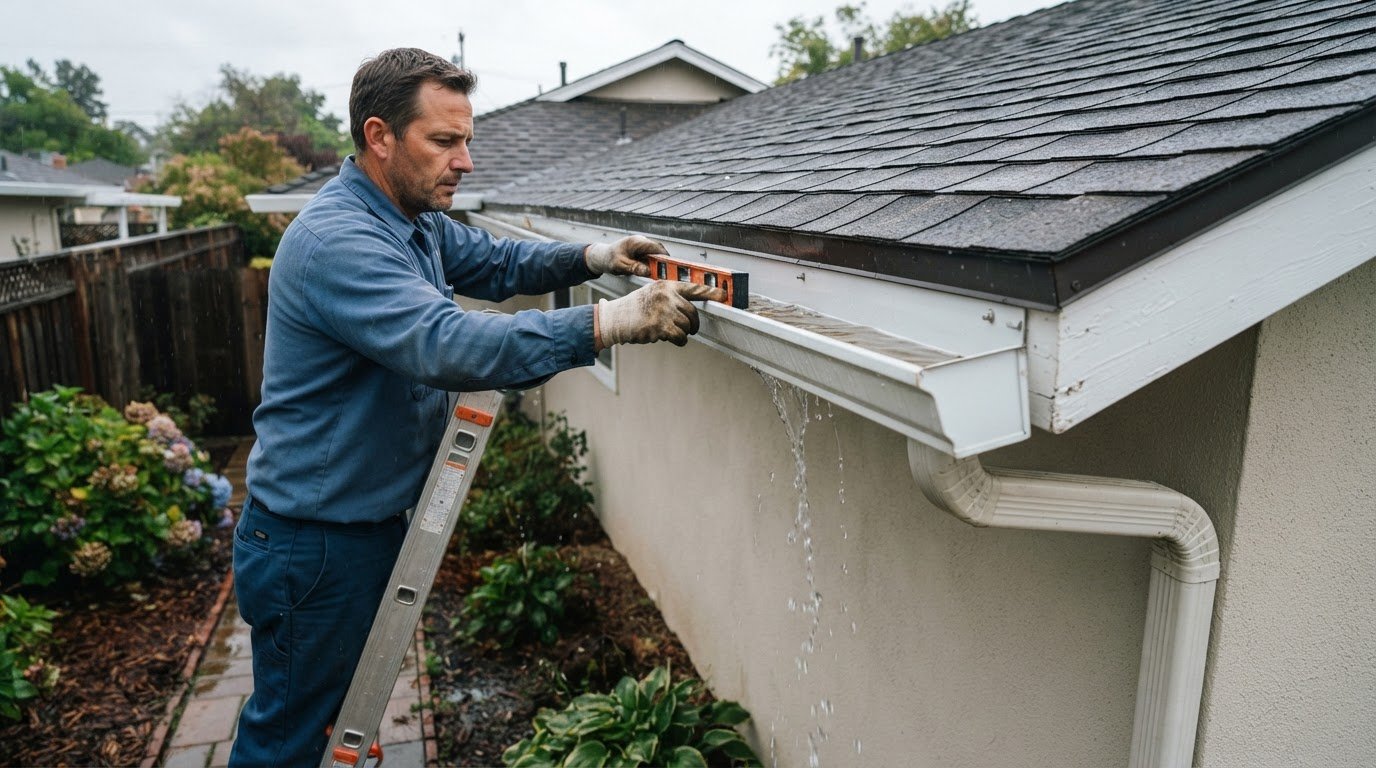
A new gutter can overflow even when it looks clean. If you’re wondering why your new gutters are overflowing, the cause may be an incorrect slope, a downspout blockage, or a gutter that can’t carry water from your roof quickly enough. Gutters should fall about 1/4 inch for every 10 feet toward a downspout, so even a subtle installation issue can leave water standing or spilling over.
It’s frustrating when new gutters overflow, especially when you expected them to protect your home. The cause may be more than debris: the roof’s catchment area, gutter capacity, downspout flow, and slope all affect drainage. This article explains how these factors lead to overflow, which signs of water damage to look for around your foundation, fascia, siding, and landscaping, and when a professional assessment can help identify the cause.
Key Takeaways
- Overflow can persist after cleaning when water is held back by a blocked downspout, an uneven gutter run, or a system that cannot keep pace with roof runoff.
- Look for signs that overflow is affecting more than the gutters, including exterior staining, soil erosion, and moisture around the foundation or fascia.
- Roof catchment area, roof pitch, and rainfall all affect how much water the gutter system needs to carry.
- A professional assessment can trace the overflow to its source and determine whether the gutter slope, capacity, or downspout needs attention.
- GTE Construction & Roofing offers gutter installation and repair for homeowners who need help resolving drainage problems.
1. Water damage to foundations, fascia, siding, and landscaping
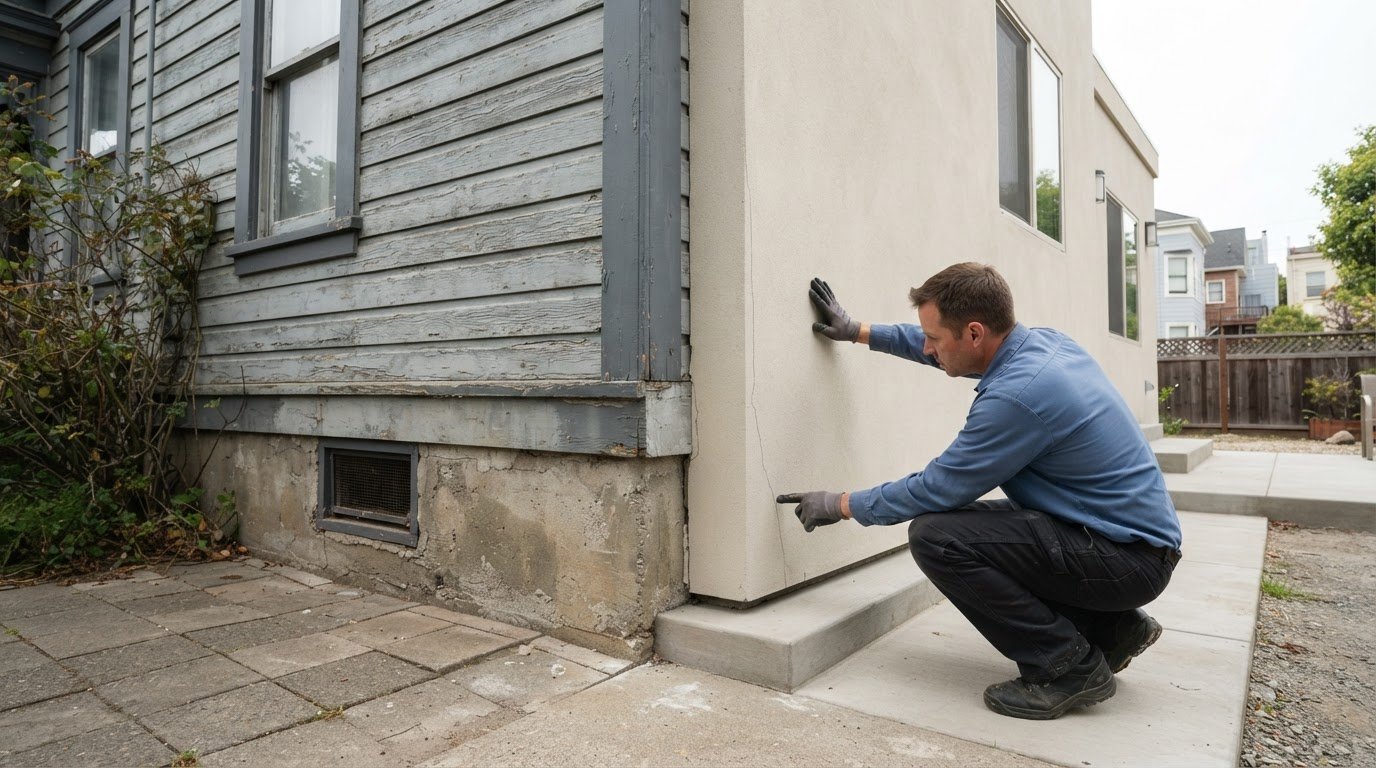
Overflowing gutters can send water down walls instead of through downspouts. After a storm, look for exterior stains beneath the roofline. Pooled water beside the foundation is another warning sign. Repeated runoff can leave soil saturated and contribute to foundation moisture problems. The Federal Emergency Management Agency highlights proper roof drainage as important for protecting homes from water damage. That makes gutter overflow more than a drainage concern.
A metal roof can shed rain quickly, sending a rush of water toward the gutter. During heavy rainfall, that water may overshoot the gutter instead of flowing inside it. Roof valleys create another concentrated path: water from two roof sections meets and rushes toward one point. If a valley empties above a gutter section, check for overflow directly below it. The location can help distinguish concentrated runoff from a leak elsewhere.
Pay particular attention to overflow at corners, where joints can leak even when the gutter is clean. Cracked or separated seams may spill water onto the fascia, the board behind the gutter. Persistent wetting can contribute to fascia rot, while moisture around the same corner may encourage mold or mildew. After rain, look for peeling paint, dark marks, or visible separation at each corner. A clean channel does not rule out a failing joint.
Overflow can stain siding, erode soil, and leave water close to the foundation. For example, a downpour spilling from one corner may carve a channel through nearby landscaping. Erosion can expose roots or displace mulch, while recurring splashes leave marks on exterior walls. Sagging gutter sections may hold water and debris, then spill when more runoff arrives. Note where water lands, not only where it leaves the roof.
Seamless gutters have fewer joints than sectional gutters, so there are fewer places for seams to crack or separate. Fewer joints can also reduce opportunities for debris blockages. Still, the system must carry roof runoff toward correctly placed downspouts. If overflow occurs beneath a roof valley or at a corner, note the pattern: a single spot may point to concentrated runoff or a joint issue, while overflow along a longer section may indicate a capacity or slope problem.
After a storm, note whether water reached the foundation, fascia, siding, or planting beds, and pinpoint where it overflowed. Clean gutters at least twice a year, and more often if trees are nearby. Homes surrounded by trees may need cleaning three or four times annually. Even a small amount of debris can trigger overflow. These observations help distinguish debris buildup from roof runoff, damaged seams, or sagging sections.
2. How much slope should gutters have to drain properly?
Gutters need a gradual pitch so water flows toward the downspout instead of sitting in the channel. A commonly recommended slope is about 1/4 inch of fall for every 10 feet of gutter run. For a 20-foot run draining in one direction, that means approximately 1/2 inch of drop from the high point. The exact direction matters: a section pitched away from its outlet can hold water, collect debris, and overflow during rain.
A professional assesses the full gutter run, not just the spot where water spills. They check whether the channel slopes consistently toward the downspout and whether sagging creates low points. For example, standing water midway along a run can point to a dip, while water collecting at the far end may mean the pitch directs it away from the outlet. Either pattern can slow drainage, even when the visible gutter surface looks clear.
Debris can look like a slope problem. Leaves, shingle grit, and other material may form a dam before the downspout, forcing water over the gutter edge. A professional can inspect the channel and outlet together: clearing only the visible section may leave a blockage near the opening. If water backs up at a corner despite an apparently clear gutter, a clogged downspout may be restricting the flow.
An underground drain can cause a similar symptom. Water may leave the downspout but back up if a buried drain is obstructed, forcing it toward the gutter again. Tree roots growing into an underground drain may require specialized equipment to clear. To diagnose the issue, a professional traces the water’s path and checks whether the problem starts in the gutter, downspout, or underground line, rather than assuming every overflow comes from poor pitch.
These causes can overlap. A gutter with a shallow or uneven slope may drain slowly, while debris or a blocked outlet further reduces its capacity during rainfall. The professional assessment should therefore distinguish a continuous pitch issue from a localized obstruction, then address the cause rather than treating the overflow alone. If the inspection identifies a damaged or poorly draining section, gutter repair can restore the intended route toward the downspout.
3. Gutter capacity relative to roof size
A gutter can be new and still undersized for the roof above it. The deciding factor is how much roof catchment area sends water into each section. One inch of rain over 1,000 square feet of horizontal roof area represents approximately 623 gallons. That volume has to travel through the gutters and downspouts during the storm. If the system cannot carry runoff quickly enough, water may spill over the edge even without debris.
Roof size alone does not tell the whole story. A steep roof, including a metal roof, can shed water quickly and overwhelm undersized gutters during heavy rain. Water arrives in a concentrated rush instead of flowing gradually into the channel. A professional assessment considers roof shape and pitch, the area draining into each gutter run, and rainfall conditions. These details can explain why one section overflows while another handles the same storm.
Common residential K-style gutters have nominal widths of 5 inches or 6 inches. A 5-inch gutter may be insufficient for heavy rainfall or a large or steep roof, while 6-inch gutters are recommended for most homes. That recommendation is a starting point, not a substitute for matching capacity to the roof’s runoff. A 4-inch gutter has less water capacity and may overflow when the connected roof area produces more runoff than it can carry.
Downspout size must match the gutter’s capacity. A typical pairing uses 2 x 3 inch downspouts with 5-inch K-style gutters, and 3 x 4 inches with 6-inch gutters. A smaller 2×3-inch downspout can contribute to overflow if runoff reaches it faster than it can drain. Increasing gutter width alone may not solve the problem if the outlet remains a bottleneck. The whole route, from roof edge to ground discharge, needs to work together.
Roof area provides a useful way to understand storm volume. The calculation is horizontal catchment area in square feet multiplied by rainfall depth in inches and 0.623 to estimate gallons. For example, one inch of rain over 500 square feet represents approximately 312 gallons; over 2,000 square feet, it represents approximately 1,246 gallons. These examples show why the area feeding a particular run matters.
Gutter and downspout placement also affects how the system handles runoff. A professional traces roof sections to their receiving gutter runs, then checks whether outlets are positioned to manage the water efficiently. If a large roof section feeds one short run, that section may overflow while nearby gutters remain clear. The useful question is not simply whether the gutters should be larger, but whether their size, downspout pairing, and placement suit the roof’s catchment area and expected water flow.

How does a professional determine whether a gutter downspout is clogged?
A professional traces water through the gutter system, from the roof edge toward the outlet. During rainfall, water backing up near a corner can point to a blocked downspout, even when the horizontal gutter looks clear. The inspection also checks for debris at the outlet, misaligned gutter sections, and visible leaks. These clues help distinguish an obstruction from a gutter that cannot handle the incoming volume.
Next, the downspout is examined along its accessible length and at its lower opening. A professional can use a small screw as a simple clearance check: if it enters the downspout and emerges below, the passage is open at that point. If it does not emerge, debris or another obstruction may be blocking it. This is one clue, not a complete diagnosis, since a blockage may be farther along the drainage route.
Some downspouts connect to underground drains, so a clear visible outlet does not always mean water can drain away. A professional checks whether water backs up where the downspout meets the buried line. Tree roots growing into an underground drain may require specialized equipment to clear. For example, overflow that continues after the visible gutter and downspout are clear may point to an underground restriction rather than an improper gutter slope.
Can downspout size, number, or placement make new gutters overflow? Yes. Too few or poorly placed downspouts can leave a long gutter run carrying more runoff than its outlets can discharge, while a smaller outlet may restrict flow. What gutter size and downspout capacity are recommended for your roof area and local rainfall? Six-inch gutters and 3×4-inch downspouts are recommended for most homes, but roof area, pitch, and rainfall affect the capacity needed.
Gutter and downspout sizing should be assessed as one system, not as separate components. A 3×4-inch downspout opening is common, while a smaller 2×3-inch downspout may contribute to overflow. The professional considers how much roof area drains into each section and whether each outlet can handle that runoff. If a blockage is found, clearing it restores the drainage path; if water still overflows, the inspection can identify whether size, number, placement, or slope also needs attention.
How professionals check gutter slope
A professional starts by tracing each gutter run toward its downspout. The inspection checks whether the channel falls consistently or forms a low point. A commonly recommended pitch is approximately 1/4 inch of fall for every 10 feet of gutter run. That reference helps identify an installation that may hold water instead of directing it toward the outlet.
Next, the professional assesses the gutter’s alignment along the roof edge. They look for sagging sections, uneven supports, and places where the channel changes direction. For example, water standing midway along a run may indicate a dip, while water remaining at the far end can suggest the slope is reversed. Either condition can slow drainage, even if the downspout is clear.
The gutter is also checked for obstructions that can disguise a slope problem. Leaves, shingle grit, or other debris can collect at an outlet and hold water back. Gutter guards may help limit debris, but periodic cleaning and inspection can still be useful. A professional considers the guard, gutter channel, and outlet together, so a blockage isn’t mistaken for improper pitch.
During the assessment, the professional compares the gutter’s direction with the location of its downspout. A run that slopes away from its outlet can leave water pooling at the opposite end. Depending on the layout, a long run may also drain in more than one direction. The inspection follows each section separately instead of assuming the entire roofline drains toward one point.
After identifying the cause, the professional determines whether the slope needs correction or another problem is disrupting water flow. Loose supports, sagging, debris, or a restricted outlet can cause similar symptoms. For instance, overflow beside siding may come from water trapped behind leaves, not necessarily from incorrect pitch. Accurate diagnosis matters because adjusting the slope alone won’t clear a clogged outlet.
A clear takeaway: the gutter should direct water steadily toward its downspout, without persistent pooling or sagging. The 1/4-inch-per-10-foot reference provides a practical benchmark, while the full run and outlet location determine how it applies. If overflow continues after cleaning, a professional slope assessment can distinguish installation issues from debris or drainage restrictions. Arrange professional gutter repair to address a faulty run or related drainage problem.
GTE Construction & Roofing
GTE Construction & Roofing can assess gutter overflow when cleaning hasn’t resolved the problem. A professional evaluation can identify whether the issue involves drainage, installation, or a section that needs repair. That distinction matters: recurring overflow may call for a correction to the gutter system, not repeated attention to the same symptom.
GTE Construction & Roofing provides gutter installation and repair, along with roofing services that can address related roof concerns in Alameda and Contra Costa Counties. If overflow continues or water is reaching your home’s exterior, note where it happens and what you’ve observed. This information gives the team useful context for assessing the problem and discussing an appropriate next step.
Contact GTE Construction & Roofing to discuss your gutter concerns.
Move from overflow symptoms to a lasting fix
If you’re still asking why your new gutters are overflowing, focus on the pattern rather than treating every spill as the same problem. Note which roof edge or corner overflows, whether it happens during heavy rain, and where the water reaches the ground. These observations give a professional a useful starting point for assessing the drainage system and its connection to the roof.
Addressing the cause early can help prevent repeated runoff from affecting your home’s exterior. GTE Construction & Roofing can discuss your gutter concerns and the appropriate next step. The company also provides New Roofing & Installation, Roofing Repair, and Kitchen Remodeling.
Contact GTE Construction & Roofing to talk through the overflow and move toward a clear plan.
Frequently Asked Questions
Why are my new gutters overflowing even after cleaning them?
Overflow that continues after cleaning often points to a drainage or capacity issue rather than debris alone. For example, water spilling from one corner may indicate a restricted outlet or leaking joint, while overflow along a longer stretch can suggest insufficient capacity or uneven pitch. Note where the water spills and whether it happens only during heavy rain. That pattern helps a professional narrow down the cause.
Will gutter guards stop my gutters from overflowing?
No. If you’re asking, “Why are my new gutters overflowing despite having guards?”, the cause may have nothing to do with leaves. Guards can reduce debris entering the channel, but they don’t correct an undersized gutter, poor slope, or clogged downspout. For example, a guarded system can still spill if heavy runoff meets a restricted outlet. Treat guards as one part of maintenance, not a fix for every drainage problem.
Can metal roofing contribute to gutter overflow?
Yes. A metal roof can shed rain quickly, sending a concentrated volume toward the gutters. During heavy rainfall, water may arrive faster than an undersized system can carry it, or it may overshoot the gutter edge. The roof’s pitch and the area draining into each section also matter. If overflow occurs below a steep roof section, a professional can assess whether runoff rate and gutter capacity are mismatched.
Do I need 6-inch gutters instead of 5-inch gutters?
Not necessarily; the right size depends on roof catchment area, roof pitch, rainfall, and downspout capacity. Six-inch gutters are recommended for most homes, while 5-inch gutters may be insufficient for heavy rainfall or a large, steep roof. A professional can assess which roof areas feed each run and whether the downspouts can handle that runoff. Gutter width alone doesn’t determine drainage performance.
How can a professional tell if a gutter downspout is clogged?
A professional checks for water backing up near the outlet or overflowing at a corner while the gutter channel appears clear. They can also inspect the accessible downspout and check whether a small screw dropped into it emerges at the bottom. If the visible downspout drains but water still backs up, an underground drain may be blocked. Tree roots in buried drains can require specialized clearing equipment.
How much rainwater do gutters actually handle?
It depends on the horizontal roof area draining into the system and the rainfall depth. To estimate runoff, multiply catchment area in square feet by rainfall depth in inches, then multiply by 0.623 for gallons. For example, one inch of rain over 1,500 square feet represents approximately 935 gallons. That water must pass through the gutters and downspouts, so roof area and outlet capacity both matter.
How much slope should gutters have to drain properly?
A commonly recommended pitch is approximately 1/4 inch of fall for every 10 feet of gutter run toward a downspout. A 20-foot run draining in one direction would have approximately 1/2 inch of drop from its high point. Professionals assess each run for consistent fall, since a low spot can hold water even when the rest drains properly. Sagging sections can also trap water and debris.
What causes gutters to overflow at the corners?
Corner overflow can result from a blocked downspout, a cracked or separated joint, or concentrated runoff from a roof valley. These causes may look similar from the ground, but their patterns differ. A downspout restriction can cause water to back up despite a clear channel; a failed seam can leak at the joint. If water pours from one corner, a professional inspection can identify the cause before repairs are chosen.