
The obvious way to finance a second-story addition may not be the best fit: refinancing replaces your current mortgage, while secondary financing can leave it in place. The right option depends on your mortgage terms, home equity, credit, and the payments you can manage. No single choice suits every homeowner.
A second-story project also needs careful planning so the financing fits the construction schedule and household budget. A cash-out refinance replaces your mortgage with a larger loan and makes the difference available as cash. A home equity loan or HELOC adds financing secured by your home, with different ways to access and repay the funds.
This guide compares those options and explains how affordability, credit, and loan-to-value ratios can affect your decision. You’ll see how a fixed-rate lump sum differs from a revolving line of credit, what repayment and collateral mean for your home, and which questions can help you narrow your choices before moving ahead.
Key Takeaways
- Compare replacing your current mortgage with borrowing against your home equity; the better fit depends partly on your existing loan terms and preferred repayment structure.
- Choose between a fixed lump sum and a flexible credit line by considering when you’ll need the funds and how you’ll manage payments.
- Assess affordability alongside credit and combined loan-to-value limits, since each can affect the financing available to you.
- Build a repayment plan that accounts for interest, closing costs, and the risk of using your home as collateral.
- Match the financing approach to the addition’s scope and construction schedule before committing to a loan.
What’s The Best Way To Finance An Addition?
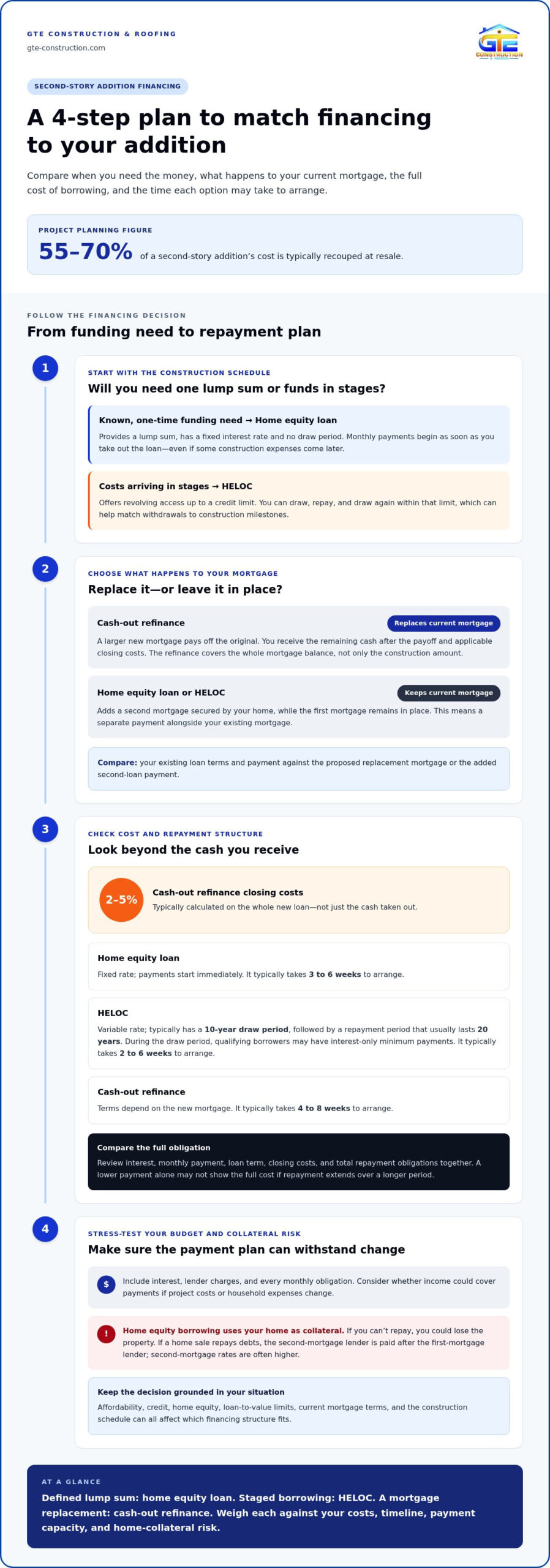
A second-story addition typically recoups 55-70% of its cost at resale. Plan for interest, lender charges, budget changes, and repayment risk because your home secures equity borrowing.
Home equity can help fund an addition while leaving your current mortgage in place. Compare payment structure, access to funds, and the risk of using your home as collateral before choosing.
Home Equity Loans
A home equity loan provides a lump sum based on your home equity, with a fixed interest rate and no draw period. Payments begin monthly as soon as you take out the loan. Because it’s secured by a home that already has a mortgage, it’s a type of second mortgage. A home equity loan typically takes 3 to 6 weeks to arrange.
The key difference between a home equity loan and a HELOC is how you get the money: a loan provides one lump sum, while a HELOC offers a revolving credit line. A lump sum may suit a project with a defined funding need, but payments begin even if construction expenses come later.
Home Equity Lines of Credit
A HELOC lets homeowners borrow against a percentage of their home equity at a variable interest rate. It typically has a 10-year draw period, followed by a repayment period that usually lasts 20 years. During the draw period, borrowers who qualify may have interest-only minimum payments.
Unlike a home equity loan, an open-end HELOC lets you draw funds up to a maximum credit limit, repay the balance, then draw again within that limit. This flexibility can help match withdrawals to construction milestones. A HELOC for an addition typically takes 2 to 6 weeks to arrange.
Home Equity Collateral Risks
Both a home equity loan and a HELOC use your home as collateral. If you can’t repay, you could lose the property. When a home sale is used to repay debts, a second-mortgage lender is paid after the first-mortgage lender, so second-mortgage rates are often higher.
Borrowing also increases your total debt and monthly obligations. Include interest and lender charges in your repayment plan, and consider whether your income could cover the payments if project costs or household expenses change. Home equity isn’t free cash; it’s borrowing secured by your home.
| Option | How funds arrive | Rate and repayment | Effect on current mortgage |
|---|---|---|---|
| Home equity loan | Lump sum | Fixed rate; payments start immediately | Leaves it in place; adds a second mortgage |
| HELOC | Revolving access during draw period | Variable rate; draw and repayment periods | Leaves it in place; adds a second mortgage |
| Cash-out refinance | Cash from the difference between the old and new mortgage | Terms depend on the new mortgage | Replaces the current mortgage |
Consider a home equity loan for a known lump-sum need, a HELOC for borrowing in stages, or refinancing if replacing your mortgage fits your plans.
Cash-out refinancing
A cash-out refinance replaces your original mortgage with a larger one and makes the difference available as cash. Before choosing this option for an addition, compare the new loan’s interest and monthly payment with your current mortgage. The funds can cover improvements, but you refinance the entire mortgage balance, not just the amount needed for construction.
How Cash-Out Refinancing Works
The lender pays off your existing mortgage using proceeds from the new loan. You receive the remaining cash after the payoff and applicable closing costs. Those costs typically equal 2 to 5 percent of the whole new loan, not just the cash taken out. That distinction matters: refinancing a large mortgage to access a smaller amount still means assessing costs against the full replacement loan.
A cash-out refinance for an addition typically takes 4 to 8 weeks to arrange. Use that timeline when planning financing alongside design and construction decisions. For example, if the work requires funds before a scheduled start, the refinance process needs to fit the project’s preparation period. The timing depends on completing the lender’s application and review process.
Review the new payment, interest rate, loan term, and closing costs together. A lower payment doesn’t reveal the full cost if repayment extends over a longer period. A higher payment may reflect a shorter term. Compare the total obligations under your current mortgage with those under the proposed replacement.
Refinancing Versus Secondary Financing
Refinancing replaces an existing loan and pays off the original mortgage. Secondary financing adds another loan secured by the home while the first mortgage remains in place. That difference affects which debt changes: a cash-out refinance restructures the first mortgage, while secondary financing preserves its current terms and adds a separate payment.
Freddie Mac secondary financing is available for purchase and refinance transactions. This means secondary financing can be paired with eligible mortgage transactions; it doesn’t refer to cash-out proceeds themselves. Consider which structure fits your goal: replacing your original mortgage or keeping it and adding a junior lien for the improvements.
Refinancing With Junior Liens
A junior lien is secondary financing behind a first mortgage. If your refinance involves a junior lien, Freddie Mac refinance mortgages with junior liens must meet the requirements in Guide Section 4204.1. Include the junior lien’s payment in your full monthly budget, alongside the replacement mortgage, before weighing available funds against repayment obligations.
Compare the estimated cash available after paying off the original mortgage and closing costs with the addition’s funding needs. Then assess the new payment alongside any junior-lien payment. This comparison helps show whether refinancing or preserving your original mortgage with secondary financing better fits your plans.
Loan affordability, credit, and repayment planning
Affordability depends on more than the loan amount approved for a home project. Before applying, list your existing monthly debts, housing payment, expected borrowing, and available income. Compare the proposed payment with your regular obligations, not just the minimum due. This gives you a practical sense of whether the renovation remains manageable after borrowing.
Assess Credit and Income
Credit history and income can affect a personal loan application. Secondary financing may be more challenging for borrowers with bad credit, though options depend on lender policies. Applicants who are self-employed or receive rental, bonus, tips, or commission income should provide tax returns for the previous two years. Organize those records before applying, and consider how the added payment fits your household budget.
Compare the full repayment obligation, not only the initial payment. The CFPB warns that refinancing a five-year car loan into a mortgage could extend payments and interest over ten, fifteen, or thirty years. This example shows why a lower monthly payment can still mean paying interest for longer. For a home project, weigh the payment amount against the repayment period and total debt.
Credit Cards and Personal Lines
For smaller renovations, a credit card can cover purchases, but pay the balance in full every month to avoid interest charges. Carrying a balance turns short-term spending into ongoing debt. A personal line of credit is another option that doesn’t use your home as collateral. A personal loan application may instead be based on your credit history and income, so compare its fixed loan amount with the project’s funding schedule.
Choose a borrowing method based on when expenses arise. A single purchase may suit a card if you can pay off the balance each month. Several purchases over time may fit a line of credit, while a personal loan provides a set amount. For each option, record the rate, required payment, repayment period, and whether the debt is secured by your home.
Secondary Financing Fees and a Practical Plan
Freddie Mac does not assess the secondary financing Credit Fee in Price on a mortgage with an Affordable Second. Freddie Mac requires Affordable Seconds to meet Guide Section 4204.2. This specific treatment does not remove the need to assess the loan’s payment and other borrowing costs within your overall budget.
Before committing, take three steps: estimate when project funds will be needed, add the proposed payment to your current monthly obligations, and compare the total with your dependable income. Include existing debt payments and plan for the full repayment period. These checks help you assess affordability without treating available credit as consequence-free spending.
Using home equity to repay other debts replaces them with a new loan; it doesn’t eliminate the debt. Include the new obligation in your repayment plan.
Secondary financing and loan-to-value ratios
Financing a second-story addition depends partly on your home’s value, existing mortgage debt, and planned borrowing. Limits on secondary financing also vary by loan program and property type.
Borrowing Limits and Combined Loan-to-Value
Combined loan-to-value compares the total loans secured by your home with its value. A lender considers your existing mortgage and proposed secondary financing together, so available equity alone doesn’t determine how much you can borrow. The applicable program limit and property value shape your borrowing room.
Loan limits also vary by mortgage program. For a single-family primary residence, the comparison lists a maximum loan-to-value ratio of 97% for a Fannie Mae HomeStyle loan. Freddie Mac mortgages with secondary financing must follow the LTV, TLTV, and HTLTV limits in Guide Chapter 4203, or the limits for the specific product. These examples are not interchangeable: the program and property type matter.
To estimate your borrowing room, start with the property value used for lending, then account for the first mortgage and any other liens. Compare the combined debt with the applicable program limit. Freddie Mac requires payments on secondary financing to be included in monthly housing expenses, so also consider your income and the resulting payment obligation.
Freddie Mac requires a junior lien’s maturity date or amortization basis to be at least five years after the first-lien note date, unless the lien is fully amortizing or a HELOC. Its terms must provide regular monthly payments sufficient to cover interest due, and interest may not accrue. Freddie Mac also requires disclosure of secondary-financing terms to the appraiser and mortgage insurer.
Construction Loan Draws and Terms
A construction loan differs from a home equity loan or HELOC because it funds a build through scheduled draws. For a second-story addition, a HELOC can also provide staged access as construction milestones are met. Construction loans typically last 12 to 18 months, with interest-only payments during the build before conversion to or replacement by a mortgage.
Construction loans are described as suitable for second stories and additions over about $250,000. A renovation construction loan typically takes 4 to 8 weeks to close when plans and a contract are ready. Renovation loans for additions may take 45 to 60 days or more, including lender review of plans and contractors. These timelines distinguish construction financing from borrowing that doesn’t require a construction review.
California allows higher loan-to-value ratios with secondary financing. Before choosing a loan, align its draw schedule with construction milestones, then compare its payment structure and combined borrowing limit. This connects funding needs with the loan terms and your household income.
Financing a second-story addition
A financing plan should account for the project scope, local approval process, and how funds will be drawn and repaid.
Available Financing Options
Options include cash-out refinancing, a home equity loan, a HELOC, personal borrowing, renovation loans, and construction loans. A cash-out refinance replaces your entire original mortgage, while a home equity loan adds a fixed-rate lump sum secured by your home. A HELOC provides revolving access to funds, and a personal line of credit doesn’t use your home as collateral.
Construction loans can suit second stories and additions over about $250,000. They commonly provide funds through construction draws, with interest-only payments during the build before conversion to or replacement by a mortgage. Compare these options by when you need funds, whether you want to keep your current mortgage, and how the payment schedule fits your income.
Steps to Get Financing
Start by defining the addition’s scope and gathering plans, contractor details, and a project budget. Estimate the loan amount needed and compare it with available equity, existing mortgage debt, credit history, and monthly payment capacity. This preparation can clarify whether a secured loan, renovation financing, or a construction loan better fits the project.
Next, align the application and lender review with the construction schedule. Renovation loans for additions may take 45 to 60 days or more to close, including review of plans and contractors. A renovation construction loan typically takes 4 to 8 weeks to close when plans and a contract are ready. A HELOC can provide staged access as construction milestones are reached.
Local Rates, Grants, and Tax Rules
Rates depend on the loan type, lender, credit profile, and property details. Location can affect secondary-financing limits: California allows higher loan-to-value ratios with secondary financing. That may influence how much homeowners can borrow, but it doesn’t determine the rate or terms for a particular loan.
Permits, zoning rules, and building-code requirements depend on the local jurisdiction. Identify them during planning, since approval conditions can affect the project scope and loan application. Assess grants and tax treatment under the rules that apply to your location and circumstances. Don’t base your budget on an assumed benefit.
To coordinate the construction scope with financing, discuss your addition project as you prepare the next steps.
For comparison, personal loans or home improvement loans may have interest rates between 8% and 15%.
GTE Construction & Roofing: New Roofing & Installation
GTE Construction & Roofing provides New Roofing & Installation and Roofing Repair for homeowners planning substantial changes to their homes. A second-story project may involve removing or replacing the existing roof, making roofing work an important part of coordinating the build. Consider the roof’s condition and the planned scope as you organize construction and financing.
If your project also includes interior updates, GTE Construction & Roofing offers Kitchen Remodeling and Bathroom Remodeling. These services can help you plan related spaces as part of a broader home project, alongside any roofing work.
For roofing work connected to your project, contact GTE Construction & Roofing to discuss the next step.
Move Your Addition Plan Forward
Financing a second-story addition is one part of preparing for construction. Start by defining the spaces and structural changes you want, then align your financing decision with the project scope. This clarity can help you move from comparing loans to making informed construction decisions.
GTE Construction & Roofing offers Home Additions, New Roofing & Installation, Roofing Repair, and Kitchen Remodeling. These services may fit plans to expand your home, address roof work, or update the kitchen as part of a broader renovation. Identify which parts of the project need attention before settling on a funding approach.
For a conversation about your home project, contact GTE Construction & Roofing. A clear plan is a practical foundation for moving ahead with confidence.
Frequently Asked Questions
How do home equity loans and HELOCs compare for funding a second-story addition?
A home equity loan may suit a project with a clearer total funding need, while a HELOC can fit costs that arise in stages. For example, if construction invoices are spread across milestones, a revolving line lets you access funds as needed rather than borrowing everything upfront. Compare the expected borrowing schedule with each option’s payment structure, and remember that both use your home as collateral.
Can a construction loan or renovation mortgage finance a second-story addition?
Yes. Construction loans can finance second-story additions, and renovation loans may cover additions when the lender reviews the project plans and contractor information. These options can differ from borrowing against existing equity because the financing is more closely tied to the planned work. Prepare a clear scope, construction plans, and contract details so the application reflects the project as well as the property.
What credit score, income, and equity are needed to qualify for addition financing?
There isn’t one universal credit score or equity threshold for every loan. Lenders assess credit history, income, existing debt payments, and home value alongside the requested loan amount. Borrowers with variable income may need to document its history, while homeowners with substantial mortgage debt may have less room under combined loan-to-value limits. For projects in San Francisco, Sacramento, Alameda County, and Contra Costa County, compare these factors with the applicable lender and program terms.