For kitchen remodel ROI in 2026, a smaller update may be the stronger resale bet: Zonda’s 2025 Cost vs. Value Report estimates a 112.9% national return for its defined minor kitchen remodel. By comparison, a midrange major remodel recoups 50.9% of its cost, while an upscale major remodel recoups 35.7%. Homeowners in San Francisco, Sacramento, Alameda County, and Contra Costa County can use these figures as national benchmarks, then weigh local buyer expectations.
That doesn’t mean a major renovation is the wrong choice. A kitchen that functions poorly or no longer suits your household may be worth improving for the years you’ll enjoy it, even if resale doesn’t repay the full investment. The key is to weigh likely resale recovery against the benefits to your day-to-day life.
This article compares minor updates with major renovations, explains how project scope and market conditions affect payback, and helps you weigh resale value against personal enjoyment. Use it to decide which improvements make sense for your home and plans.
Key Takeaways
- Compare the project’s full scope with its likely resale recovery; larger renovations can improve daily function without paying back their entire cost at sale.
- ROI measures recovered resale value against renovation cost, not the comfort or usefulness you gain while living with the changes.
- For homes in San Francisco, Sacramento, Alameda County, and Contra Costa County, weigh national benchmarks alongside local buyer expectations.
- Match the renovation’s scale to your home, neighborhood, and plans for when you may sell to reduce the risk of over-improving.
- Balance resale potential with the benefits you’ll enjoy during ownership, so the project serves your household as well as a future buyer.
How Do Minor Kitchen Updates Compare to Major Renovations?
National benchmarks generally show stronger immediate resale recovery for defined minor updates than for major renovations. For homeowners in San Francisco, Sacramento, Alameda County, and Contra Costa County, these figures are a comparison point, not a local prediction. Project scope and local buyer priorities still matter.
Cost and Resale-Value Benchmarks
Cost and resale-value benchmarks compare renovation spending with the estimated value recovered at sale. According to Zonda’s 2025 Cost vs. Value Report, its defined minor kitchen remodel has a 112.9% national return. The reported recoup rate is 50.9% for a midrange major remodel and 35.7% for an upscale major remodel. These tiers help homeowners compare scopes before planning work.
For homes in the Bay Area or Sacramento, interpret national estimates alongside local conditions. Buyers may respond differently to a dated kitchen than to one with a practical layout and well-maintained finishes. Compare your home’s condition with nearby properties, then identify changes that address a visible or functional gap.
Budgets Relative to Home Value
A home-value-based budget relates renovation spending to the property’s overall value. A 5-15% share is presented as a defensible resale budget; homeowners planning to sell within five years are advised to invest no more than 10%. This frame can help avoid a renovation that exceeds what the home and its market can support.
In San Francisco, Sacramento, Alameda County, and Contra Costa County, property values and buyer expectations vary by neighborhood. Use the percentage as a planning guide, not a fixed spending instruction. A kitchen with functional cabinets may need a narrower scope than one with damaged components or a layout that makes everyday use difficult.
What Zonda’s Benchmark Measures
Zonda published its 2025 Cost vs. Value Report on April 15, 2026. According to Zonda, the report surveyed real estate professionals, contractors, and home sales across 119 U.S. markets. Its national return reflects defined project scopes across those markets, rather than a guarantee for an individual home in San Francisco or Sacramento.
Local resale outcomes also depend on condition, workmanship, materials, and buyer preferences. A broad renovation may improve how a kitchen functions while recovering less at resale than a smaller, well-targeted update. Compare national benchmarks with project plans of similar scope.
Full Renovations, Permits, and Resale
A full kitchen remodel may combine new finishes with layout changes or structural work, so its resale recovery differs from a cosmetic refresh. Permit and building-code requirements depend on local jurisdiction and project scope. In San Francisco, Sacramento, Alameda County, and Contra Costa County, changes involving structural elements, plumbing, or electrical systems may require review under applicable local requirements.
There is no single average kitchen remodel cost that describes every 2026 project, because scope, materials, labor, and existing conditions differ. A cosmetic update, cabinet replacement, and renovation involving structural work are distinct projects. Compare estimates by the work included, then weigh that scope against the kitchen’s condition and local buyer expectations.
Kitchen Remodel ROI in 2026: What Pays Back, and What Makes Sense?
Return depends on the project’s scope, the local market, and the value buyers place on the finished kitchen. Start by applying the same calculation to each project you compare.
Calculating Renovation ROI
Renovation ROI compares the resale value added with the project cost, expressed as a percentage of that cost. For example, a $50,000 renovation adding $40,000 in resale value produces an 80% ROI. The calculation helps separate resale recovery from personal value: it measures what the improvement may return at sale, not the comfort or convenience enjoyed meanwhile.
Apply the same method to a refresh, cabinet work, or a broader remodel. Estimate the added resale value, subtract the renovation cost, then divide that difference by the cost. A positive result above 100% means estimated added value exceeds spending; a lower result means some cost remains unrecovered. Scope must stay consistent when comparing estimates.
Choosing a Renovation Scope
A targeted refresh updates selected finishes, while cabinet refacing renews existing cabinet fronts and a broader remodel may change the layout. Reported estimates put cabinet refacing at 72% ROI, while a targeted refresh may recover 70% to 85% of its cost. These comparisons can help households focus improvements on worn surfaces rather than replacing sound components.
Choose a scope that matches your goal. If the kitchen functions well, refreshed finishes or countertops may address its most visible shortcomings. If storage, workflow, or layout creates daily friction, broader changes may better serve your household. If resale is a priority, consider how neutral finishes may appeal to buyers.
Regional Differences in Returns
Regional returns compare similar renovation categories across different housing markets. In 2025, a minor kitchen remodel had a reported ROI of 129% in the Pacific region and 94.5% in the West North Central region. Other U.S. regions ranged from 101% to 134%. The spread shows why a national estimate may not reflect local resale conditions.
State results can differ, too: Maine had the highest kitchen remodel ROI among the states listed, at 167%. Local buyer expectations and home values influence how an improvement is perceived, so regional context matters when setting priorities. For household goals, place the most weight on functional needs and durable finishes, then compare the scope with local resale expectations.
Budget categories also reveal where a project’s value is concentrated. Cabinets or cabinet refacing commonly account for 25-35% of a kitchen remodel budget, making their condition and finish choices important planning decisions. Countertops, appliances, and layout changes can shift the remaining allocation, while a contingency helps accommodate unforeseen work. For a tailored project scope, explore kitchen remodeling options.
Renovation benefits for resale versus personal enjoyment
A kitchen renovation can serve two purposes: improve resale appeal and make daily routines work better. Zillow’s 2024 survey found that kitchen style mattered greatly to 57% of buyers.
National Averages and Local Outcomes
National averages summarize renovation returns across many markets, while local resale outcomes reflect the homes and buyers in a particular area. National figures can’t show which finishes or functional features local buyers prioritize.
Zillow found that 38% of sellers who made pre-listing improvements chose to update their kitchen. Treat that as evidence of sellers’ interest, not a guarantee of local payback. Compare nearby homes with similar layouts and condition, then consider whether your proposed work addresses a visible gap in those examples.
Homeowner Satisfaction and Resale Returns
Resale return measures estimated value recovered at sale; homeowner satisfaction reflects the experience of using the renovated kitchen. U.S. kitchen upgrades received a Joy Score of 10/10 in 2025, showing that financial recovery is only one way to assess a project.
For example, a homeowner who cooks often may value a more functional layout, durable hardware, or easier-to-clean finishes, even if those choices don’t raise resale value by the same amount. Separate the expected resale benefit from personal benefits when deciding how much of the project serves each goal.
Cabinet Longevity and Resale Condition
Cabinet longevity affects resale through the kitchen’s visible condition and everyday function. Builder-grade kitchens may look new for five years but appear dated and worn by year ten. That makes cabinet condition relevant when deciding whether to refinish, reface, or replace.
Cabinetry is also described as the kitchen’s 30-year layer, so replacement choices can shape the room for much of a homeowner’s stay. Inspect door surfaces, hinges, drawer operation, and storage before settling on a scope. If the cabinet boxes remain sound, updating doors or hardware may preserve useful components while refreshing appearance.
Minor Updates and Resale ROI
Minor updates focus on selected finishes or components rather than rebuilding the entire kitchen. A 2026 estimate places immediate resale recoupment for a minor refresh costing $25,000-$45,000 at 70-95%. This range helps homeowners weigh a targeted improvement against a broader renovation.
The cost-versus-value comparison is most useful when the planned work matches the benchmark’s scope. Refreshing worn surfaces differs from replacing cabinets or changing the layout. If the kitchen functions well but looks dated, targeted finishes may address its main resale drawback without adding work your household doesn’t need.
Before choosing a scope, list functional problems and visible wear, then rank them by importance. A clear list helps shape the renovation and distinguish improvements that support resale from those that chiefly improve daily enjoyment.
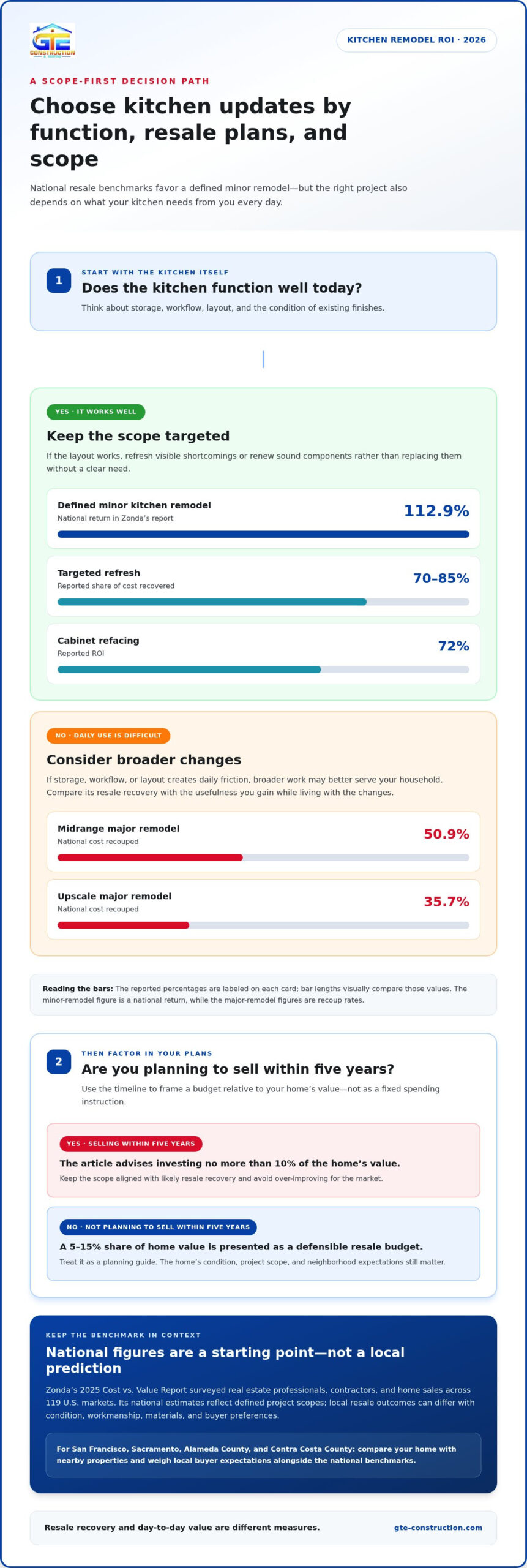
2026 Kitchen remodel recoup rates by project tier
Zonda estimates a 112.9% national return for its defined minor kitchen remodel. Garage doors returned 268%, steel entry doors 216%; kitchen scope, materials, and labor shape costs and resale value.
Recoup Rates Across Project Tiers
A recoup rate compares estimated resale value gained with the renovation investment. For immediate resale in 2026, an upscale kitchen remodel is estimated to recoup 30-45% of its cost. Major kitchen renovations costing $80,000+ are stated to return 53%. These benchmarks help homeowners compare scope before deciding how much value to prioritize.
The project tier matters because broader work can add features without recovering the full investment at resale. A defined minor remodel has a higher reported national return than upscale work, while a major renovation may address more extensive functional needs. Treat each rate as a benchmark for its project category, not a promise for every home.
Compare the kitchen figures with exterior projects to put their relative returns in context. The 2025 Cost vs. Value data reports a 268% return for garage-door replacement and 216% for steel entry-door replacement. Those figures exceed kitchen remodel benchmarks, but the projects serve different purposes and shouldn’t be treated as interchangeable investments.
Kitchen Upgrades and Resale Value
Kitchen upgrades can support resale when they improve condition, function, or buyer appeal without expanding the scope unnecessarily. No single finish is best for every home. A minor remodel leads the listed kitchen tiers by reported recoup rate, but the right choice depends on the kitchen’s current condition and local buyer priorities.
Project scope, materials, and labor affect both the investment and the finished result. Replacing sound components adds work, while durable, broadly appealing finishes can support buyer interest. Layout changes or structural work add complexity compared with a focused surface refresh. Define the needed work first, then compare how each material or change affects function and overall scope.
Cabinet planning is especially consequential: 68% of U.S. homeowners renovating kitchens replace all cabinets. That makes it worth assessing cabinet condition before choosing replacement over a more limited update. If cabinets function well, keeping them may leave more room for other improvements; worn or poorly arranged storage may justify a broader plan. Custom choices can improve daily use, but their resale appeal depends on fit with the home.
Use recoup rates as one part of your home improvement decision. Match the project tier to the kitchen’s needs, your household’s plans, and features buyers value locally. A focused update may suit a sound but dated kitchen; a major renovation makes more sense when function or condition calls for broader work.
Minor remodels versus major renovations
A minor kitchen project preserves more of the existing room, while a major renovation changes more components or systems. The right comparison depends on whether you’re selling soon or need a better kitchen for daily use.
Minor Updates and Full Gut Remodels
A minor update refreshes selected surfaces or appliances; a full gut remodel replaces much more of the kitchen. Greater scope can address more problems, but doesn’t automatically deliver stronger resale recovery.
For a kitchen with a workable layout and sound cabinets, selective improvements can address worn finishes without rebuilding functional parts. A gut remodel may make sense when the room has broader shortcomings, such as poor flow or outdated systems. If you plan to sell soon, separate necessary repairs from changes that mainly reflect personal preferences.
Comparing Minor and Major Remodels
A minor kitchen remodel generally concentrates on visible improvements, while a major project changes more of the room. In the 2025 Cost vs. Value data, a minor kitchen remodel had a reported ROI of 113%. A midrange major kitchen remodel recouped 50.9% of its cost, illustrating how project scale can affect resale recovery.
Scope also shapes how materials and labor contribute to the finished result. Replacing cabinets, altering the layout, and updating appliances involve different work from refreshing existing finishes. Before committing, list what doesn’t function, what looks worn, and what could remain. This clarifies the difference between a targeted improvement and a larger renovation.
Returns From Minor Kitchen Remodels
A minor kitchen remodel’s return compares its estimated resale value with its project cost. The 113% reported return means the benchmark’s estimated resale value exceeded its cost. It’s a useful reference for homeowners weighing updates before selling, but the result applies to the defined minor-remodel category, not every project labeled “minor.”
Use the benchmark alongside the kitchen’s condition and your timeline. A small refresh may be appropriate if the appliances work, storage is adequate, and the layout suits buyers. If cabinets or systems need broader attention, a minor project may leave important problems unresolved. Home value and local buyer expectations also influence which improvements make sense.
For a practical scope comparison, identify which changes support function and which mainly add personal appeal. A focused kitchen remodeling project can align the work with your goals, whether you plan to sell or stay and enjoy the improvements.
GTE Construction & Roofing: New Roofing & Installation
GTE Construction & Roofing provides kitchen remodeling for homeowners weighing targeted updates against a broader renovation. Define what the kitchen needs to do better, which components require attention, and how long you expect to enjoy the changes before selling. That scope helps align decisions about layout, finishes, and functionality with your household’s priorities.
If your plans also include roofing work, GTE Construction & Roofing offers new roofing installation and roofing repairs. Keeping each project’s goals clear helps distinguish what belongs in the renovation from what can be planned separately.
For a kitchen project shaped around your home and priorities, contact GTE Construction & Roofing or visit gte-construction.com.
Make Your Next Kitchen Decision With Confidence
Let the kitchen remodel ROI for 2026 inform your decision, not make it for you. Before planning work, identify what you want the room to do better, what needs attention, and how long you expect to stay. That gives you a practical way to distinguish essential improvements from optional upgrades, and to shape a project around your priorities rather than resale alone.
A clear scope makes the next conversation more productive. Consider how the layout supports your routines, which finishes you want to keep, and what changes would make daily use easier. With those priorities in view, you can discuss a renovation suited to your home and plans.
GTE Construction & Roofing can help with kitchen remodeling. Contact GTE Construction & Roofing to discuss your kitchen project, and take the next step toward a space that works well for you.
Frequently Asked Questions
When might a targeted kitchen update be enough?
A targeted update may be enough when the kitchen works well but looks dated or has a few visible problems. If cabinets remain sturdy and the layout suits your household, refreshing selected finishes or replacing worn hardware can improve appearance without changing the whole room. This approach is less suitable when storage, workflow, or damaged components create persistent problems. Start by separating cosmetic concerns from functional ones.
Are luxury renovations worth the investment?
Luxury renovations can be worthwhile for personal enjoyment, but they often recover less at immediate resale than smaller updates. The 2025 Cost vs. Value data reports a 35.7% recoup rate for an upscale major kitchen remodel. A custom feature may suit your preferences, yet buyers may not value it at its full cost. Consider how long you expect to use the kitchen and whether the added features solve a real need.
Do high-end appliances increase home value?
High-end appliances can enhance a kitchen, but their resale contribution may not match their purchase cost. Reported estimates put the return for premium appliances at 57%, compared with 71% for mid-range models. A premium range may make sense if cooking performance matters to your household, but it’s less compelling as a resale-only upgrade. Buyers also assess how well appliances fit the room’s overall condition and finish quality.
Do kitchen and bathroom remodels have a high return on investment?
Returns vary by project type, so neither category guarantees a high payback. The 2025 Cost vs. Value data reports a 73.7% ROI for a midrange bathroom remodel, compared with 50.9% recouped for a midrange major kitchen remodel. These benchmarks describe different scopes and shouldn’t be treated as direct predictions for your home. Addressing worn or poorly functioning spaces can still improve daily comfort and buyer appeal.
How do I calculate renovation ROI before starting?
Estimate ROI by dividing the resale value added by the renovation cost, then expressing the result as a percentage. For instance, a $50,000 project that adds $40,000 in resale value produces an 80% ROI. Before work begins, define which improvements are included and estimate their likely contribution separately from personal benefits. A new pantry layout may improve everyday use even when its resale contribution is difficult to isolate.
What is the 2026 ROI for a minor kitchen remodel?
The strongest defined national benchmark is Zonda’s 2025 Cost vs. Value Report, which estimates a 112.9% return for its minor kitchen remodel. Zonda published the report on April 15, 2026, so it provides a current benchmark, not a guaranteed outcome for every 2026 project. Check that your planned work resembles the report’s defined scope before applying its rate to your own resale expectations.
What is the 2026 ROI for a major or upscale kitchen remodel?
For immediate resale in 2026, estimates place upscale kitchen remodel recoupment at 30-45%. Major kitchen renovations costing $80,000+ are stated to return 53%. These figures describe different project categories, so don’t combine them into one expected rate. A major remodel can still make sense if it corrects a poor layout or substantial functional problems, particularly when you plan to enjoy the improvements before selling.
How much home value does a kitchen remodel add in 2026?
Added value depends on the project tier and local resale conditions. The larger estimate doesn’t mean a major project delivers better proportional payback, because its cost also differs. Use these figures as category benchmarks, then consider whether your home’s condition and buyer expectations support the planned scope.