The most natural-looking kitchen cabinet isn’t automatically the most practical. The main types of kitchen cabinet materials include MDF, wood veneer, and particleboard, each balancing appearance, moisture resistance, durability, maintenance, and cost differently. The right choice depends on how you use your kitchen and the finish you want.
It’s easy to focus on color and style when comparing cabinets, but what’s beneath the surface matters just as much. Smooth painted finishes, visible wood grain, and easy-care surfaces each have different maintenance needs and vulnerabilities, especially around moisture and everyday wear.
This comparison explains how MDF, wood veneer, and particleboard are made, how their surfaces look, and how they perform over time. You’ll also learn what care each material needs and which trade-offs to weigh, helping you narrow your options before planning a kitchen update.
Key Takeaways
- Look beyond cabinet-door appearance: the core material and surface finish shape durability, moisture resistance, and day-to-day care.
- MDF offers a smooth base for painted or covered finishes, but prolonged water exposure can cause swelling and damage.
- Wood veneer brings a natural wood appearance with a lighter construction; its backing and protection from moisture affect how well it holds up.
- Particleboard can suit budget-conscious choices, but water sensitivity makes careful cleaning and prompt spill management important.
- Use your kitchen’s exposure to moisture, expected wear, and preferred appearance to narrow the options before planning a remodel.
MDF grades, finishes, and formaldehyde considerations
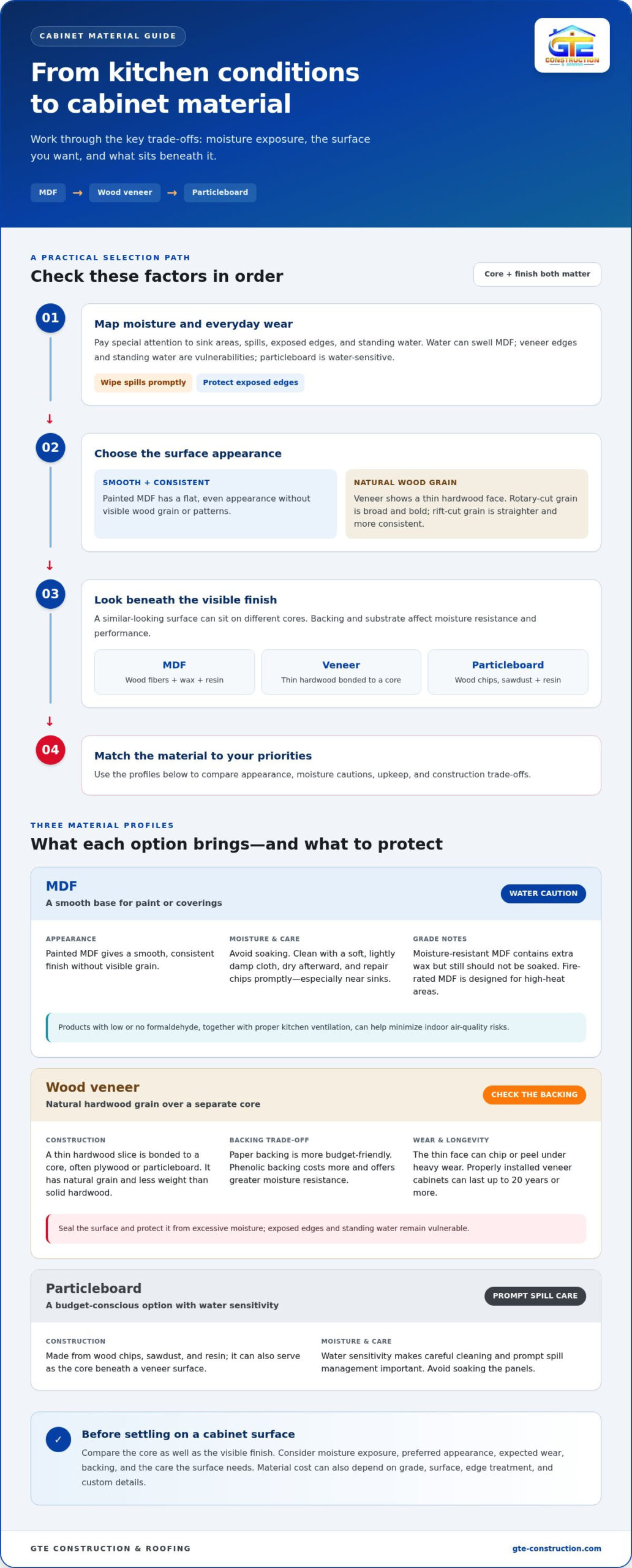
MDF cabinets are made from wood fibers, wax, and resin, then finished with a protective or decorative surface. MDF can work well in kitchens, but soaking can cause swelling and damage.
MDF Grades and Formaldehyde
MDF is made by combining wood fibers with wax and a resin binder. Moisture-resistant MDF includes extra wax for protection, but it still shouldn’t be soaked. Products with low or no formaldehyde, combined with proper kitchen ventilation, can help minimize indoor air quality risks. Fire-rated MDF is designed for high-heat areas, while standard MDF offers a smooth base for paint or coverings.
Painted MDF
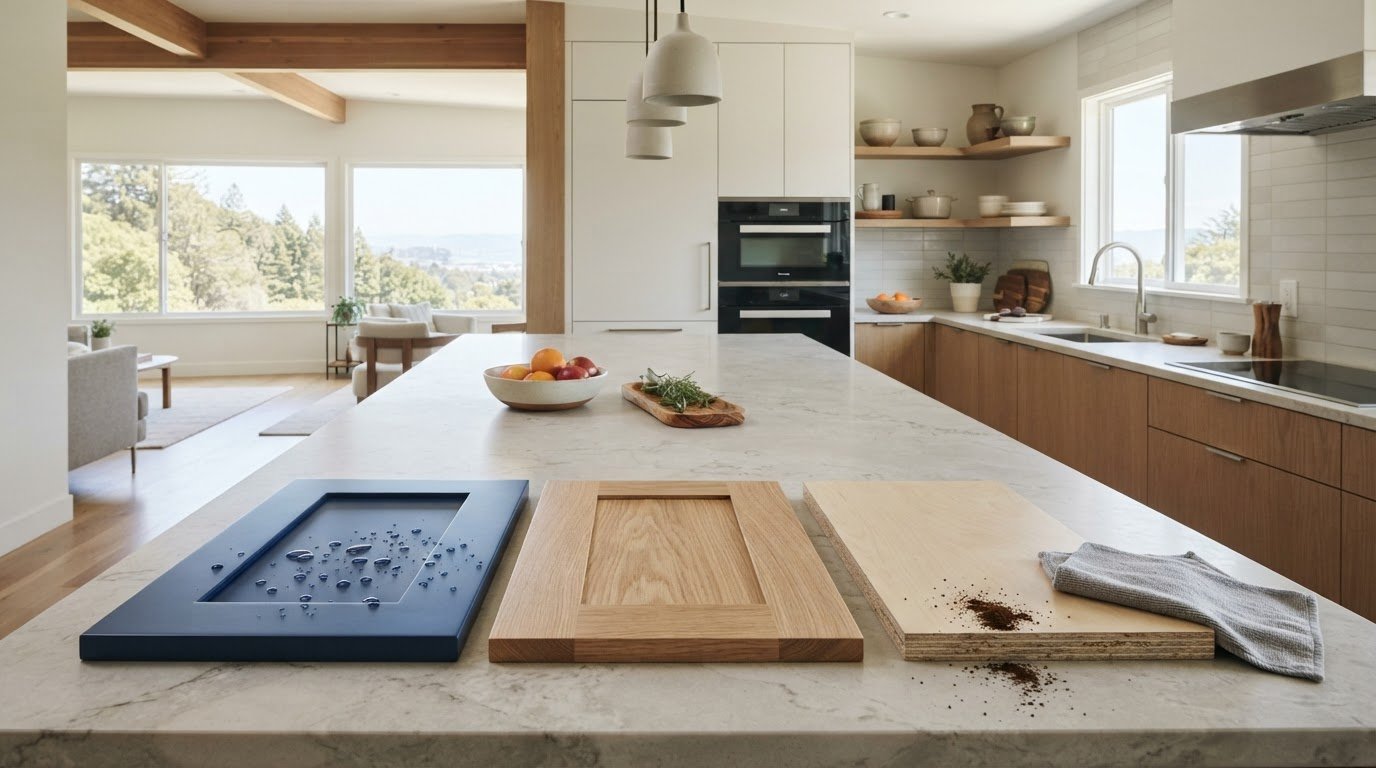
Painted MDF has a smooth, consistent appearance without visible wood grain or patterns. Its flat surface suits contemporary styles and custom colors, unlike the natural look of veneer. Clean painted doors with a soft, lightly damp cloth, then dry them, especially near sinks. Since water can swell MDF, repair chips promptly and don’t leave spills on exposed edges.
Decorative Melamine Finishes
Melamine is a decorative plastic surface bonded to an MDF or particleboard core. It provides uniform colors or printed patterns without the grain variation of natural wood. The surface offers some scratch resistance, but it can’t be sanded and refinished. If the coating chips and water reaches the core, the substrate can swell, so protect damaged edges from moisture.
High-Pressure Laminate Finishes
High-pressure laminate is made by fusing layers of paper and plastic resin under high pressure. Its durable, easy-to-clean surface suits busy kitchens and resists scratches, heat, and stains. Compared with thermofoil, it is more durable: pressure sealing helps prevent moisture-related peeling. However, repairs are limited, and a damaged laminate cabinet surface can’t be repaired.
Laminate can cover MDF, while wood veneer provides a more natural grain. Plywood is another possible cabinet core, so compare the substrate as well as the visible finish. Material cost depends on grade, surface, edge treatment, and custom details. Protecting exposed edges and caring for the finish as directed help maintain the result.
| Option | Core or construction | Appearance | Moisture and care |
|---|---|---|---|
| Painted MDF | Wood fibers, wax, resin | Smooth, consistent color | Prevent soaking; protect chips |
| Melamine | Decorative surface over MDF or particleboard | Solid colors or printed patterns | Don’t sand; guard chipped edges |
| High-pressure laminate | Paper and plastic resin layers | Uniform decorative surface | Wipe clean; damaged surfaces can’t be repaired |
Choose a core, finish, and care routine suited to your kitchen’s moisture exposure and the appearance you prefer.
Wood veneer construction, backing, and moisture resistance
Wood veneer combines a thin hardwood surface with a less expensive core, so both the visible grain and the material beneath it matter. Backing, sealing, and everyday moisture exposure affect its appearance and durability.
In the United States, cabinet material costs vary with species, construction, finish, and customization. Solid wood costs more than some alternatives. Paper-backed veneer is budget-friendly, while phenolic-backed veneer costs more and offers greater moisture resistance.
Wood Veneer
Wood veneer is a thin slice of hardwood bonded to a core, often plywood or particleboard. It offers natural grain with less weight than solid hardwood, reducing strain on hinges, but its thin surface can chip or peel under heavy wear. Paper backing is more budget-friendly; phenolic backing costs more and can form a moisture-tight seal. Seal the surface and protect it from excessive moisture.
The cut also shapes the look. Rotary-cut veneer peels a log in a circular motion, creating broad, bold grain suited to contemporary styles. Rift-cut veneer produces straighter, more consistent grain and reduces fleck patterns in some woods, including oak. Properly installed veneer cabinets can last up to 20 years or more, but exposed edges and standing water remain vulnerabilities.
Engineered Wood
Engineered wood is made by joining wood layers, particles, or fibers rather than using one unbroken piece. Plywood panels consist of thin wood-veneer layers bonded with alternating grain directions, strengthening the panel and reducing the risk of splitting. Particleboard, by contrast, uses wood chips, sawdust, and resin. Both differ from solid wood, whose natural grain runs through the material rather than forming a thin decorative face over a core.
Plywood is strong, durable, and more resistant to warping than many cabinet materials, though excessive water can still damage it. A suitable finish helps protect plywood from moisture and humidity. Wipe spills promptly instead of soaking panels during cleaning. The core matters: veneer surfaces can look similar across different substrates, but the backing affects resistance and performance.
Solid wood offers a different balance. Oak, maple, cherry, and hickory are examples of hardwoods made from single, unbroken pieces. They can withstand heavy use, and their surfaces can be stained, painted, or refinished. Refinishing may update the appearance without replacing the cabinets, while sanding or buffing can address scratches. These advantages often come with a higher material cost than some alternatives.
Natural wood responds to its environment. Humidity and water exposure can cause solid wood to expand, shrink, warp, or crack, while changing light can fade or darken its color. Keep cabinet surfaces dry and maintain a consistent indoor environment to reduce moisture-related damage. Veneer also needs a protective finish, but its thin hardwood layer is less suited to heavy wear than solid wood.
For a kitchen update, kitchen remodeling can help bring material, finish, and cabinet construction choices together in one coordinated plan.
Particleboard construction, cost, and water sensitivity
Particleboard cabinets use compressed wood particles and resin, often beneath a decorative surface. Their suitability depends on moisture exposure, the finish, and how the cabinet will be used.
Particleboard cabinets are made from wood chips, sawdust, and resin bonded under pressure. Compared with plywood, particleboard is more susceptible to water damage; plywood uses bonded wood-veneer layers and is generally stronger and more durable. The U.S. Environmental Protection Agency identifies particleboard as core stock for cabinet sides, backs, drawers, and doors.
Core Material and Cost
Particleboard can be a practical core for several cabinet components, but its sensitivity to water is an important trade-off. Cabinet material cost depends on the core, surface, door construction, and finish, not just the visible color. During a remodel, compare the full cabinet specification: a decorative surface doesn’t change the water sensitivity of the particleboard beneath it.
Consider where each cabinet will be used. A particleboard cabinet beside a sink or dishwasher may face spills, damp cloths, or leaks, so dry the area promptly. For shelves holding heavy cookware, plywood is often stronger and more durable than particleboard. Choosing the core for each cabinet’s role helps balance cost, durability, and moisture exposure.
Thermofoil and Melamine
Thermofoil is vinyl laminate heated and molded over MDF or engineered wood. Its continuous surface is easy to wipe, but heat can damage it and chips can be difficult to repair. Keep hot appliances and cookware from resting against thermofoil doors, and use a soft cloth for routine cleaning. Its appeal is a smooth, uniform finish, not high-heat resistance.
Melamine is a decorative plastic bonded to particleboard or MDF. It offers moderate durability and some scratch resistance, with colors and patterns that create a consistent look. The coating helps shield the core during ordinary use, but chips can let water reach the substrate and cause swelling. Clean with a damp cloth, dry the surface, and address chips before moisture reaches the core.
Hardwood Cabinets
Hardwood cabinets made from oak, maple, cherry, or hickory can withstand heavy use. Their natural beauty comes with care considerations: humidity can contribute to warping, and water may cause wood to expand, shrink, or crack. Wipe spills promptly and maintain the finish. Solid wood can be stained, painted, or refinished, but it costs more than some other materials.
For a practical comparison, match each cabinet’s location with its core and surface: protect particleboard from water, keep thermofoil away from heat, and maintain hardwood finishes.
Cabinet material selection by appearance, durability, and maintenance
Laminate, thermofoil, and wood veneer differ in appearance, surface durability, and care needs. Compare each finish with its core, since cabinet doors, boxes, and drawer fronts may use MDF, particleboard, plywood, or hardwood.
Laminate Finishes
Laminate covers a cabinet substrate with a decorative surface, offering a range of colors and patterns without natural grain variation. High-pressure laminate resists scratches, heat, and stains, making it practical for heavily used surfaces. It resists moisture-related peeling better than thermofoil, though damage can still let water reach a vulnerable core. Clean it with a soft cloth and avoid abrasive tools.
Properly finished plywood and phenolic-backed veneer offer useful moisture resistance, but excessive water can still damage them. Laminate resists heat and scratches, while thermofoil is vulnerable to heat. No finish makes cabinets dent-proof; the substrate and force of impact also matter.
Thermofoil Finishes
Thermofoil is vinyl laminate heated and molded over MDF or engineered wood. Its smooth, uniform appearance suits simple contemporary styles, and the surface wipes clean with a damp cloth. Heat is its key weakness: hot cookware or appliances placed against a door can damage the covering. Chipped thermofoil can be difficult to repair, so avoid impacts and keep heat sources away from cabinet fronts.
Compared with high-pressure laminate, thermofoil is less resistant to moisture-related peeling. Its continuous surface simplifies routine cleaning, but damaged edges need attention because the covering protects an underlying core. Choose thermofoil for a consistent finish where heat exposure is limited, not for a cabinet beside an appliance that transfers heat directly.
Wood Veneer Finishes
Wood veneer bonds a thin slice of hardwood to a less expensive core, such as plywood or particleboard. It provides real grain and natural variation that printed surfaces can’t duplicate. Cherry veneer, for example, has a distinctive wood appearance, while painted finishes offer more uniform color. Veneer is lighter than solid hardwood, but its thin surface can chip or peel under heavy wear.
Seal veneer and protect it from excessive moisture to preserve its appearance. A protective finish helps, but veneer is less suited to heavy wear than solid wood. Its backing matters: plywood offers strength, paper backing is budget-friendly, and phenolic backing provides greater moisture resistance. Select the grain, backing, and finish together for a cohesive look.
Match the finish to each cabinet’s location and everyday demands. For example, prioritize heat resistance near cooking appliances and moisture protection beside the sink. Hardwood can be refinished, while melamine can’t be sanded and refinished once its decorative layer is applied. Consider whether you want visible grain, painted color, or a consistent printed pattern.
Plan care around the finish: wipe spills promptly, dry damp surfaces, and protect exposed edges from impact. These steps help preserve the surface but can’t prevent every scratch, chip, or dent. Weigh appearance against the maintenance and exposure expected in each part of the kitchen.
What is the difference between solid wood and engineered wood kitchen cabinets?
Solid wood uses natural lumber, while engineered wood is made by bonding wood layers, particles, or fibers. This difference affects appearance, construction, moisture response, refinishing, and material choices for cabinet doors, boxes, and shelves.
Hardwood cabinets use single, unbroken pieces of wood, such as oak, maple, cherry, or hickory. Their natural grain means each door can vary in pattern and color. Solid wood can withstand heavy use and be stained, painted, or refinished. However, water exposure or changing humidity can cause it to warp, shrink, expand, or crack.
Engineered wood covers several types of construction. The United States Court of International Trade describes engineered wood products as including plywood, strand board, particleboard, and fiberboard. These materials use layers, particles, or fibers rather than one continuous piece of lumber. Their properties depend on how they’re assembled and finished.
| Cabinet material | Construction | Practical distinction |
|---|---|---|
| Solid wood | Single, unbroken pieces of natural wood | Can be refinished; responds to moisture and humidity |
| Plywood | Thin wood layers bonded with alternating grain directions | Strong construction that resists warping |
| MDF | Wood fibers, wax, and resin binder | Smooth base for paint or surface finishes |
| Particleboard | Wood chips, sawdust, and resin bonded under pressure | Water can damage the core |
Plywood uses multiple veneer layers with alternating grain directions to add strength and reduce the risk of splitting. Properly finished plywood resists water better than many cabinet materials, but excessive water can still damage it. MDF provides a smooth surface for paint, though it can swell when soaked. Particleboard can serve as cabinet core stock, but protect it from spills and leaks.
Solid wood can be refinished to update its appearance without full replacement. Scratches may be sanded or buffed, and a new stain or paint can change the finish. Engineered materials generally rely more on their applied surface; melamine, for example, can’t be sanded and refinished once its decorative layer is applied. This makes the face material and edge protection important considerations.
For a well-used kitchen, compare each cabinet component as well as the material name. Plywood shelves are often stronger and more durable than particleboard shelves. A painted MDF door has a different look and care routine from a hardwood door, while a veneer face pairs natural grain with an engineered core. Match each choice to moisture exposure, expected wear, and preferred appearance.
Use these distinctions to plan a remodel that balances natural wood character with practical construction. Plan your kitchen remodeling project around the cabinet materials and finishes that suit your home.
GTE Construction & Roofing: New Roofing & Installation
GTE Construction & Roofing offers Kitchen Remodeling to help homeowners carry cabinet material decisions into a broader kitchen update. Turn to the team when planning new cabinets, weighing finishes, or coordinating cabinet choices with other parts of the remodel. A clear plan can align appearance, daily care, and construction details with how you use the kitchen. GTE Construction & Roofing also provides New Roofing & Installation and Roofing Repair for homeowners addressing roofing needs separately from an interior project.
For guidance on your kitchen plans, contact GTE Construction & Roofing or visit gte-construction.com.
Plan Your Kitchen With Confidence
Your cabinet choice is part of a larger design, so consider how you want the kitchen to feel and function when the work is complete. Before settling on the types of kitchen cabinet materials, think about which surfaces you touch most, where spills are likely, and how much upkeep fits your routine. This practical approach can turn a preferred look into a lasting, considered decision.
For homeowners ready to bring those choices into a renovation, GTE Construction & Roofing offers Kitchen Remodeling. The company also handles New Roofing & Installation and Roofing Repair, so homeowners can discuss separate interior and roofing projects with the same business. Share your kitchen goals and material priorities to begin planning the next step.
Contact GTE Construction & Roofing to discuss your project. A thoughtful plan can help you move forward with greater clarity and create a kitchen that feels right for your home.
Frequently Asked Questions
7 Best Kitchen Cabinet Materials: Which One Is Right For You?
There isn’t one best choice for every kitchen; match the material to its job. Consider solid wood for a natural surface you may refinish, plywood for sturdy cabinet construction, and MDF for a smooth painted look. Particleboard, wood veneer, laminate, and thermofoil each offer different combinations of surface and core. For example, prioritize an easy-to-wipe finish for a busy kitchen, or visible wood grain if natural variation matters most.
What are the main types of kitchen cabinet materials?
The main types of kitchen cabinet materials include solid wood, plywood, MDF, and particleboard, along with surface options such as wood veneer, laminate, and thermofoil. These terms don’t all describe the same layer: plywood, MDF, and particleboard commonly serve as cores, while veneer and laminate describe visible surfaces. When comparing cabinets, identify the material used for the box, door, and drawer front rather than relying on one label.
What are the pros and cons of plywood kitchen cabinets?
Plywood’s layered construction makes cabinet panels strong and helps them resist warping, while its water resistance is better than that of many cabinet materials. Excessive water can still cause damage, so avoid soaking it during cleaning and dry spills promptly. As a practical check, inspect exposed edges and the finish near a sink, where frequent splashes make surface protection especially useful.
Which cabinet materials are easiest to maintain, repair, or refinish?
Laminate is easy to clean and resists scratches, heat, and stains, but a damaged laminate surface can’t be repaired. Solid wood needs more finish care, yet scratches can be sanded or buffed and the surface refinished. Melamine needs gentle cleaning because its decorative layer can’t be sanded and refinished. Choose based on the upkeep you prefer: simple wiping, surface repair, or periodic refinishing.
Which kitchen cabinet materials resist water, heat, scratches, and dents best?
High-pressure laminate resists scratches, heat, and stains, while plywood is more water-resistant than many cabinet materials. Phenolic-backed veneer offers greater moisture resistance than paper-backed veneer; aluminum is prone to denting.
How much do kitchen cabinets cost by material in the United States?
Costs vary with the core, species, surface, finish, construction, and customization. Solid wood generally costs more than some alternatives; paper-backed veneer is budget-friendly, while phenolic-backed veneer costs more. Particleboard may suit budget-conscious choices.